>
Salmoniformes (Salmons) >
Salmonidae (Salmonids) > Coregoninae
Etymology: Coregonus: Greek, kore = pupils of the eye + Greek, gonia = angle (Ref. 45335).
More on author: Linnaeus.
Environnement : milieu / zone climatique / profondeur / gamme de distribution
Écologie
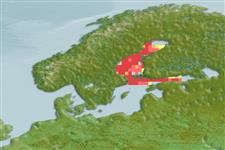
marin; eau douce; saumâtre benthopélagique; anadrome (Ref. 138280); profondeur 30 - ? m. Temperate; 66°N - 59°N, 16°E - 31°E
Europe: Baltic basin, lakes of upper Volga drainage (Seliger, Vseluga, Perejaslavskoe), some lakes of White sea basin and North Sea basin east of Elbe drainage. Anadromous in Gulf of Finland and marine in northernmost freshened part of Gulf of Bothnia; north to about 69° N in Lake Inari, northern Finland; lower Rhine (now extirpated). Frequently stocked in lakes and reservoirs in Germany and Poland.
Taille / Poids / Âge
Maturité: Lm ? range ? - ? cm
Max length : 48.0 cm TL mâle / non sexé; (Ref. 556); common length : 20.0 cm TL mâle / non sexé; (Ref. 556); poids max. publié: 1.0 kg (Ref. 556); âge max. reporté: 10 années (Ref. 593)
Description synthétique
Clés d'identification | Morphologie | Morphométrie
Épines dorsales (Total) : 0; Rayons mous dorsaux (Total) : 11 - 13; Épines anales: 0; Rayons mous anaux: 13 - 17.
Body shape (shape guide): fusiform / normal.
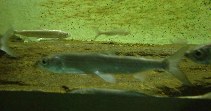
Lacustrine and marine in open water. At sea, forages close to coast (Ref. 59043). Adults form pelagic schools in deeper lakes (Ref. 4779). Spawning occurs along shores, at 3-10 m depth, rarely to 22 m depth or just below surface, in deeper in clear lakes and closer to surface in lakes with humic waters (Ref. 59043), on shallow sand or gravel substrate. Anadromous in the Baltic. Adults feed on planktonic crustaceans (Ref. 4779).
Ascend a short distance up the rivers in shoals in late August to mid-October. Mature in the second year (lacustrine forms later) and the young ones descend in late summer (Ref. 4779).
Svetovidov, A.N., 1984. Salmonidae. p. 373-385. In P.J.P. Whitehead, M.-L. Bauchot, J.-C. Hureau, J. Nielsen and E. Tortonese (eds.) Fishes of the north-eastern Atlantic and the Mediterranean. UNESCO, Paris. vol. 1. (Ref. 4779)
Statut dans la liste rouge de l'IUCN (Ref. 130435: Version 2025-2 (Global))
Menace pour l'homme
Harmless
Utilisations par l'homme
Pêcheries: commercial; Aquaculture: expérimental
Outils
Articles particuliers
Télécharger en XML
Sources Internet
Estimations basées sur des modèles
Température préférée (Réf.
123201): 2.1 - 4.5, mean 2.6 °C (based on 38 cells).
Indice de diversité phylogénétique (Réf.
82804): PD
50 = 0.5000 [Uniqueness, from 0.5 = low to 2.0 = high].
Bayesian length-weight: a=0.00468 (0.00390 - 0.00560), b=3.21 (3.17 - 3.25), in cm total length, based on LWR estimates for this species (Ref.
93245).
Niveau trophique (Réf.
69278): 3.1 ±0.2 se; based on diet studies.
Résilience (Réf.
120179): Milieu, temps minimum de doublement de population : 1,4 à 4,4 années (K=0.3-0.7; tm=2; tmax=10; Fec=2,000).
Vulnérabilité de la pêche (Ref.
59153): Moderate vulnerability (35 of 100).
🛈
Vulnérabilité climatique (Ref.
125649): High vulnerability (62 of 100).
🛈
Nutriments (Ref.
124155): Calcium = 21.4 [13.3, 39.0] mg/100g; Iron = 0.364 [0.260, 0.521] mg/100g; Protein = 17.7 [16.5, 18.8] %; Omega3 = 1.12 [0.49, 2.91] g/100g; Selenium = 17.9 [8.0, 39.0] μg/100g; VitaminA = 13.8 [5.2, 36.5] μg/100g; Zinc = 0.609 [0.504, 0.716] mg/100g (wet weight); based on
nutrient studies.