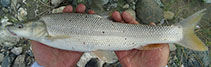
Lingkungan: lingkungan / zona iklim / kisaran kedalaman / jangkauan distribusi
Ekologi
; air tawar; payau bentopelagis; anadromus (ruaya dari laut ke air tawar) (Ref. 59043). Temperate
Europe and Asia: Caspian basin, from Volga southward to Atrek (Iran); Aral basin in Amu Darya, Syr Darya and Chu drainages.
Ukuran / Berat / umur
Kematangan: Lm ? range ? - ? cm
Max length : 105 cm TL jantan/; (Ref. 1441); common length : 65.0 cm TL jantan/; (Ref. 1441); Berat maksimum terpublikasi: 15.0 kg (Ref. 59043)
deskripsi pendek
Kunci identifiaksi (pengenalan) | Morfologi | Morfometrik
Duri punggung (Keseluruhan (total)) : 4; duri punggung lunak (Keseluruhan (total)) : 8; Duri dubur: 2; Sirip dubur lunak: 5. Diagnosed from other species of Barbus and Luciobarbus in Caspian Se basin by having the following characters: predorsal length longer than postdorsal length; dorsal fin with 8½ branched rays; 12-18 gill rakers; back between head and dorsal origin laterally compressed, forming a keel; lateral line with 52-72 (usually 60-66) scales; and lower lip thin, without median lobe or pad (Ref. 59043).
Body shape (shape guide): elongated.
Adults occur in the sea, mostly close to shores and forages also in estuaries. They are semi-anadromous and non-anadromous, rarely landlocked in reservoirs. Adults and juveniles feed on invertebrates, algae, detritus, plant material, and small fishes, while larvae prey on zooplankton and small benthic invertebrates. Spawn in lowland streams and rivers on sand-gravel bottom, usually in strong current. Undertake migration to uppermost tributaries of rivers. Non-anadromous populations begin to migrate during late summer-autumn and spawn following spring, but some enter rivers in early spring and spawn same year. Migration by non-anadromous populations takes place just before spawning to upper stretches of tributaries or spawn in lakes and reservoirs on sand to mud bottom (Ref. 59043).
Siklus hidup dan perilaku kawin
Kematangan | Reproduksi, perkembang biakan | Pemijahan | telur-telur | Fekunditas | Larva
Kottelat, M. and J. Freyhof, 2007. Handbook of European freshwater fishes. Publications Kottelat, Cornol and Freyhof, Berlin. 646 pp. (Ref. 59043)
Status IUCN Red List (Ref. 130435: Version 2025-2 (Global))
ancaman kepada manusia
Harmless
penggunaan manusia
Alat, peralatan
laporan khas
muat turun XML
Sumber internet
Estimasi berdasarkan model
Indeks keanekaragaman filogenetik (Acuan
82804): PD
50 = 0.5000 [Uniqueness, from 0.5 = low to 2.0 = high].
Bayesian length-weight: a=0.00617 (0.00304 - 0.01252), b=3.06 (2.89 - 3.23), in cm total length, based on LWR estimates for this Genus-body shape (Ref.
93245).
Tingkat Trofik (Acuan
69278): 2.8 ±0.3 se; based on size and trophs of closest relatives
Daya lenting (Acuan
120179): Rendah, Waktu penggandaan populasi minimum 4.5 - 14 tahun (tm=3-7; Fec=15,000-125,000).
Kerentanan Penangkapan Ikan (Ref.
59153): High vulnerability (63 of 100).
🛈