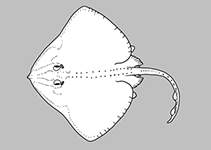
分类 / 名称
俗名 | 同种异名 | Catalog of Fishes(属, 种) | ITIS | CoL | WoRMS | Cloffa
Elasmobranchii
板鳃亚纲 (鲨鱼与 鱼) (sharks and rays) >
Rajiformes (Skates and rays) >
Arhynchobatidae (Softnose skates)
Etymology: simoterus: Name probably derived from the comparative tense of the Greek σιμóς, meaning 'pug-nosed', referring to its rounded snout (Ref. 89865).
环境:氛围 / 气候带 / 深度上下限 / 分布范围
生态学
海洋 居于水底的; 深度上下限 96 - 540 m (Ref. 89865). 溫帶
分布
领土 | FAO区域 | 生态系 | 标本纪录 | 分布图 | 简介 | Faunafri
Northwest Pacific: off northern Japan.
西北太平洋: 外海的日本北部。
大小 / 重量 / 年龄
成熟度: Lm ? range ? - ? cm
Max length : 101 cm TL 雄鱼/尚未辨别雌雄; (Ref. 89865)
简单描述
检索表 | 型态特徵 | 形态测量图
This species is distinguished from all other members of the subgenus Arctoraja by having a complete row of dorsal thorns, narrow interdorsal space, high count of precaudal vertebrae, and COI haplotype. It is further distinguished from B. parmifera by its narrower interdorsal space 0.5-1.0% TL (vs. 1.0-3.9% TL), number of precaudal and caudal vertebrae 41 and 90 (vs. 32-40 and 82-89), tail thorns 22-28 (vs. 15-23), larger orbit 4.3-5.3% TL (vs. 2.6-4.8% TL), 3 postdorsal foramina slightly smaller posteriorly, posteriormost postventral foramina 4 times larger than preceding 6 foramina (vs. anterior- and posterior-most postdorsal and postventral foramina of the scapulacoracoid larger than 3 intervening foramina), distal projection of the ventral marginal directed distally (vs. distolaterally), ventral terminal lanceolate (vs. tear-drop shaped), dorsal and ventral marginals extending farther distally to distal tip of dorsal terminal 3 (vs. extending to about a quarter the length of dorsal terminal 2); from B. panthera by its narrow interdorsal space width (vs. 1.4-3.1% TL); anterior portion of body shorter and narrower (vs. longer and wider); tail shorter (vs. longer); posterior fontanelle narrowly elongate (vs. pear-shaped); internal carotid foramina widely separated (vs. foramina in a single median pit), foramen of scapulocoracoid all large (vs. anterior postdorsal foramen large, others much smaller), ventral terminal lanceolate (vs. tear-drop shaped); from the incompletely thorned B. smirnovi by its higher number of vertebrae 131 (vs. 118-127), more precaudal vertebrae 41 (vs. 31-38), smaller mouth size 8.1-9.1% TL (vs. 8.3-11.6% TL), neurocranium with 2 fontanelles (vs. 1), internal carotid foramina widely separated (vs. close together in a single pit), scapulocoracoid with 3 foramina, more posterior each slightly smaller (vs. 5 foramina, anterior- and posteriormost larger than three intermediates), and pelvic girdle with two obturator foramina widely spaced (vs. close together) (Ref. 89865).
Body shape (shape guide): other.
Oviparous. Distinct pairing with embrace. Young may tend to follow large objects, such as their mother (Ref. 205). Eggs are oblong capsules with stiff pointed horns at the corners deposited in sandy or muddy flats (Ref. 205). Egg capsules are 12.0 cm long and 9.0 cm wide (Ref. 41253).
卵生的。 明显的成对出现。 幼鱼可能倾向跟随大的个体, 例如他们的母亲.(参考文献 205) 卵为长方形鞘囊具有僵硬的触角沈积在沙滩或泥滩的角落.(参考文献 205) 卵鞘是 12.0 公分长与 9.0 公分宽的.(参考文献 41253)
生命周期和交配行为
成熟度 | 繁殖 | 产卵场 | 卵 | 孕卵数 | 仔鱼
Oviparous, paired eggs are laid. Embryos feed solely on yolk (Ref. 50449). Distinct pairing with embrace. Young may tend to follow large objects, such as their mother (Ref. 205). Eggs have horn-like projections on the shell (Ref. 205).西北太平洋: 外海的日本北部。
McEachran, J.D. and K.A. Dunn, 1998. Phylogenetic analysis of skates, a morphologically conservative clade of elasmobranchs (Chondrichthyes: Rajidae). Copeia 1998(2):271-290. (Ref. 27314)
世界自然保护联盟红皮书 (Ref. 130435: Version 2025-2 (Global))
人类利用
工具
特别资料
下载 XML
网络资源
基于模型的估算
首选温度 (参考文献
123201): 1 - 17.6, mean 11.8 °C (based on 33 cells).
系统发育多样性指数 (参考文献
82804): PD
50 = 0.6250 [Uniqueness, from 0.5 = low to 2.0 = high].
Bayesian length-weight: a=0.00550 (0.00279 - 0.01081), b=3.11 (2.94 - 3.28), in cm total length, based on LWR estimates for this (Sub)family-body shape (Ref.
93245).
营养阶层 (参考文献
69278): 3.9 ±0.7 se; based on size and trophs of closest relatives
回复力 (参考文献
120179): 低的, 最小族群倍增时间4.5 - 14 年 (Fec assumed to be <100).
渔业脆弱性 (Ref.
59153): High vulnerability (61 of 100).
🛈