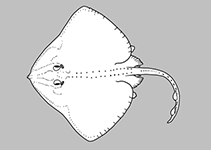
Elasmobranchii (tubarões e raias) (sharks and rays) >
Rajiformes (Skates and rays) >
Arhynchobatidae (Softnose skates)
Etymology: simoterus: Name probably derived from the comparative tense of the Greek σιμóς, meaning 'pug-nosed', referring to its rounded snout (Ref. 89865).
Ambiente: milieu / zona climática / intervalo de profundidade / gama de distribuição
Ecologia
marinhas demersal; intervalo de profundidade 96 - 540 m (Ref. 89865). Temperate
Northwest Pacific: off northern Japan.
Tamanho / Peso / Idade
Maturidade: Lm ? range ? - ? cm
Max length : 101 cm TL macho/indeterminado; (Ref. 89865)
Descrição breve
Chaves de identificação | Morfologia | Morfometria
This species is distinguished from all other members of the subgenus Arctoraja by having a complete row of dorsal thorns, narrow interdorsal space, high count of precaudal vertebrae, and COI haplotype. It is further distinguished from B. parmifera by its narrower interdorsal space 0.5-1.0% TL (vs. 1.0-3.9% TL), number of precaudal and caudal vertebrae 41 and 90 (vs. 32-40 and 82-89), tail thorns 22-28 (vs. 15-23), larger orbit 4.3-5.3% TL (vs. 2.6-4.8% TL), 3 postdorsal foramina slightly smaller posteriorly, posteriormost postventral foramina 4 times larger than preceding 6 foramina (vs. anterior- and posterior-most postdorsal and postventral foramina of the scapulacoracoid larger than 3 intervening foramina), distal projection of the ventral marginal directed distally (vs. distolaterally), ventral terminal lanceolate (vs. tear-drop shaped), dorsal and ventral marginals extending farther distally to distal tip of dorsal terminal 3 (vs. extending to about a quarter the length of dorsal terminal 2); from B. panthera by its narrow interdorsal space width (vs. 1.4-3.1% TL); anterior portion of body shorter and narrower (vs. longer and wider); tail shorter (vs. longer); posterior fontanelle narrowly elongate (vs. pear-shaped); internal carotid foramina widely separated (vs. foramina in a single median pit), foramen of scapulocoracoid all large (vs. anterior postdorsal foramen large, others much smaller), ventral terminal lanceolate (vs. tear-drop shaped); from the incompletely thorned B. smirnovi by its higher number of vertebrae 131 (vs. 118-127), more precaudal vertebrae 41 (vs. 31-38), smaller mouth size 8.1-9.1% TL (vs. 8.3-11.6% TL), neurocranium with 2 fontanelles (vs. 1), internal carotid foramina widely separated (vs. close together in a single pit), scapulocoracoid with 3 foramina, more posterior each slightly smaller (vs. 5 foramina, anterior- and posteriormost larger than three intermediates), and pelvic girdle with two obturator foramina widely spaced (vs. close together) (Ref. 89865).
Body shape (shape guide): other.
Oviparous. Distinct pairing with embrace. Young may tend to follow large objects, such as their mother (Ref. 205). Eggs are oblong capsules with stiff pointed horns at the corners deposited in sandy or muddy flats (Ref. 205). Egg capsules are 12.0 cm long and 9.0 cm wide (Ref. 41253).
Ciclo de vida e comportamento de acasalamento
Maturidade | Reprodução | Desova | Ovos | Fecundidade | Larvas
Oviparous, paired eggs are laid. Embryos feed solely on yolk (Ref. 50449). Distinct pairing with embrace. Young may tend to follow large objects, such as their mother (Ref. 205). Eggs have horn-like projections on the shell (Ref. 205).
McEachran, J.D. and K.A. Dunn, 1998. Phylogenetic analysis of skates, a morphologically conservative clade of elasmobranchs (Chondrichthyes: Rajidae). Copeia 1998(2):271-290. (Ref. 27314)
Categoria na Lista Vermelha da IUCN (Ref. 130435: Version 2025-2 (Global))
Ameaça para o homem
Harmless
Utilização humana
Ferramentas
Relatórios especiais
Descarregue XML
Fontes da internet
Estimativas baseadas em modelos
Temperatura preferida (Ref.
123201): 1 - 17.6, mean 11.8 °C (based on 33 cells).
Índice de diversidade filogenética (Ref.
82804): PD
50 = 0.6250 [Uniqueness, from 0.5 = low to 2.0 = high].
Bayesian length-weight: a=0.00550 (0.00279 - 0.01081), b=3.11 (2.94 - 3.28), in cm total length, based on LWR estimates for this (Sub)family-body shape (Ref.
93245).
Nível Trófico (Ref.
69278): 3.9 ±0.7 se; based on size and trophs of closest relatives
Resiliência (Ref.
120179): Baixo, tempo mínimo de duplicação da população 4,5 - 14 anos (Fec assumed to be <100).
Vulnerabilidade da pesca (Ref.
59153): High vulnerability (61 of 100).
🛈