Élasmobranches (requins et raies) (sharks and rays) >
Rajiformes (Skates and rays) >
Arhynchobatidae (Softnose skates)
Etymology: Bathyraja: Greek, bathys = deep + Latin, raja, -ae = a ray (Raja sp) (Ref. 45335).
Eponymy: Dr Kiyomatsu Matsubara (1907–1968) was originally called Kiyomatsu Sakamoto but on marrying he took his wife’s name as the family surname. [...] (Ref. 128868), visit book page.
Environnement : milieu / zone climatique / profondeur / gamme de distribution
Écologie
marin bathydémersal; profondeur 120 - 2000 m (Ref. 50550). Deep-water
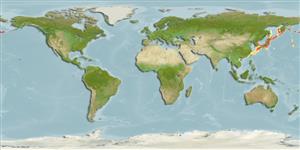
Northwest Pacific: off northern Japan (Ref. 559) and Sea of Okhotsk (Ref. 41724).
Longueur à la première maturité / Taille / Poids / Âge
Maturité: Lm 97.0, range 89 - 105 cm
Max length : 126 cm TL mâle / non sexé; (Ref. 56527); poids max. publié: 10.6 kg (Ref. 56527)
Description synthétique
Clés d'identification | Morphologie | Morphométrie
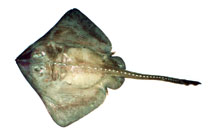
Differs from its congeners in having a dark purplish brown color at both sides of the body; eyeball as long as the spiracle; interorbital space smooth; clasper with deep cleft (Ref. 75535).
Body shape (shape guide): other.
Deep-sea species (Ref. 8630). Small individuals feed on crabs and annelids, while larger ones prey on fish and cephalopods (Ref. 27640). Oviparous. Distinct pairing with embrace. Young may tend to follow large objects, such as their mother (Ref. 205). Eggs are oblong capsules with stiff pointed horns at the corners deposited in sandy or muddy flats (Ref. 205). Egg capsules are 10.9-11.3 cm long and 6.5-6.7 cm wide (Ref. 41249, 41253).
Cycle de vie et comportement reproducteur
Maturité | Reproduction | Frai | Œufs | Fécondité | Larves
Oviparous, paired eggs are laid. Embryos feed solely on yolk (Ref. 50449). Distinct pairing with embrace. Young may tend to follow large objects, such as their mother (Ref. 205). Eggs have horn-like projections on the shell (Ref. 205).
McEachran, J.D. and K.A. Dunn, 1998. Phylogenetic analysis of skates, a morphologically conservative clade of elasmobranchs (Chondrichthyes: Rajidae). Copeia 1998(2):271-290. (Ref. 27314)
Statut dans la liste rouge de l'IUCN (Ref. 130435: Version 2025-2 (Global))
Menace pour l'homme
Harmless
Utilisations par l'homme
Pêcheries: sans intérêt
Outils
Articles particuliers
Télécharger en XML
Sources Internet
Estimations basées sur des modèles
Température préférée (Réf.
123201): 0.3 - 4.1, mean 2 °C (based on 173 cells).
Indice de diversité phylogénétique (Réf.
82804): PD
50 = 0.5000 [Uniqueness, from 0.5 = low to 2.0 = high].
Bayesian length-weight: a=0.00427 (0.00273 - 0.00666), b=3.09 (2.96 - 3.22), in cm total length, based on LWR estimates for this species & Genus-body shape (Ref.
93245).
Niveau trophique (Réf.
69278): 4.1 ±0.72 se; based on food items.
Résilience (Réf.
120179): Faible, temps minimum de doublement de population : 4,5 à 14 années (Fec assumed to be <100).
Vulnérabilité de la pêche (Ref.
59153): Very high vulnerability (76 of 100).
🛈