Elasmobranchii (haaien en roggen) (sharks and rays) >
Rajiformes (Skates and rays) >
Arhynchobatidae (Softnose skates)
Etymology: Bathyraja: Greek, bathys = deep + Latin, raja, -ae = a ray (Raja sp) (Ref. 45335).
Eponymy: Dr Kiyomatsu Matsubara (1907–1968) was originally called Kiyomatsu Sakamoto but on marrying he took his wife’s name as the family surname. [...] (Ref. 128868), visit book page.
Milieu: milieu / Klimaatzone / Diepte / verspreidingsgebied
Ecologie
marien bathydemersaal; diepte 120 - 2000 m (Ref. 50550). Deep-water
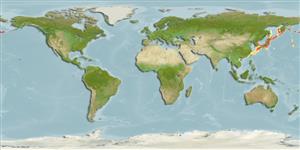
Northwest Pacific: off northern Japan (Ref. 559) and Sea of Okhotsk (Ref. 41724).
Lengte bij maturiteit / Grootte / Gewicht / Leeftijd
Maturiteit: Lm 97.0, range 89 - 105 cm
Max length : 126 cm TL mannelijk / geslacht onbekend; (Ref. 56527); max. gepubliceerd gewicht: 10.6 kg (Ref. 56527)
Korte beschrijving
Determinatiesleutels | Morfologie | Morfometrie
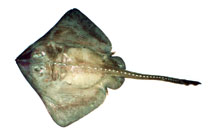
Differs from its congeners in having a dark purplish brown color at both sides of the body; eyeball as long as the spiracle; interorbital space smooth; clasper with deep cleft (Ref. 75535).
Body shape (shape guide): other.
Deep-sea species (Ref. 8630). Small individuals feed on crabs and annelids, while larger ones prey on fish and cephalopods (Ref. 27640). Oviparous. Distinct pairing with embrace. Young may tend to follow large objects, such as their mother (Ref. 205). Eggs are oblong capsules with stiff pointed horns at the corners deposited in sandy or muddy flats (Ref. 205). Egg capsules are 10.9-11.3 cm long and 6.5-6.7 cm wide (Ref. 41249, 41253).
Levenscyclus en paargedrag
Maturiteit | Voortplanting | Paaien | Eieren | Fecunditeit | Larven
Oviparous, paired eggs are laid. Embryos feed solely on yolk (Ref. 50449). Distinct pairing with embrace. Young may tend to follow large objects, such as their mother (Ref. 205). Eggs have horn-like projections on the shell (Ref. 205).
McEachran, J.D. and K.A. Dunn, 1998. Phylogenetic analysis of skates, a morphologically conservative clade of elasmobranchs (Chondrichthyes: Rajidae). Copeia 1998(2):271-290. (Ref. 27314)
Status op de Rode Lijst van het IUCN (Ref. 130435: Version 2025-2 (Global))
Gevaar voor de mens
Harmless
Gebruik door de mens
Visserij: van geen belang
Tools
Speciale rapporten
Download XML
Internetbronnen
Schattingen op basis van modellen
Gewenste temperatuur (Ref.
123201): 0.3 - 4.1, mean 2 °C (based on 173 cells).
Fylogenetische diversiteitsindex (Ref.
82804): PD
50 = 0.5000 [Uniqueness, from 0.5 = low to 2.0 = high].
Bayesian length-weight: a=0.00427 (0.00273 - 0.00666), b=3.09 (2.96 - 3.22), in cm total length, based on LWR estimates for this species & Genus-body shape (Ref.
93245).
Trofisch niveau (Ref.
69278): 4.1 ±0.72 se; based on food items.
Weerstandsvermogen (Ref.
120179): laag, minimale populatieverdubbelingstijd 4,5-14 jaar (Fec assumed to be <100).
Kwetsbaarheid van de visserij (Ref.
59153): Very high vulnerability (76 of 100).
🛈