Meio ambiente: milieu / Zona climática / intervalo de profundidade / faixa de distribuição
Ecologia
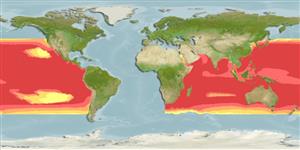
marinhas pelagic-oceanic; oceanódromo (Ref. 71039); intervalo de profundidade 0 - 915 m (Ref. 43), usually 0 - 200 m (Ref. 43). Subtropical; 15°C - 30°C (Ref. 43); 44°N - 47°S, 18°E - 69°W (Ref. 43)
Indo-Pacific: tropical and subtropical waters, occasionally entering temperate waters. Stray individuals migrate into the Atlantic Ocean by way of the Cape of Good Hope, but the existence of Atlantic breeding stocks is unlikely. Highly migratory species.
Tamanho / Peso / Idade
Maturidade: Lm ? range ? - ? cm
Max length : 465 cm FL macho/indeterminado; (Ref. 40637); common length : 380 cm TL macho/indeterminado; (Ref. 30573); peso máx. publicado: 750.0 kg (Ref. 5503)
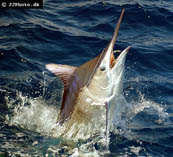
Espinhos dorsais (total) : 0; Raios dorsais (total) : 39 - 50; Espinhos anais: 0; Raios anais : 16 - 21. Body elongate and not very compressed; upper jaw produced into a robust but not very long beak; two dorsal fins, the height of the first less then the greatest body depth, becoming shorter posteriorly; pectoral fins falcate and rigid, with 19 to 20 rays; body densely covered with small, embedded scales with 1 or 2 sharp points; back dark blue; belly silvery white; membrane of first dorsal fin blue black, without spots; flanks without spots (Ref. 55763). Dark blue above, silvery white below; sometimes with light blue vertical stripes; 1st dorsal fin blackish to dark blue, other fins dark brown with tinges of dark blue in some specimens.
Body shape (shape guide): elongated.
Oceanic, usually found in surface waters above the thermocline, often near shore close to land masses, islands and coral reefs. Feed on fishes, squids, cuttlefishes, octopods, large decapod crustaceans and mostly on small tunas when abundant (Ref. 9668). The flesh is of good quality; marketed refrigerated or frozen and prepared as sashimi in Japan (Ref. 9308). Also Ref. 9692.
Ciclo de vida ou comportamento de acasalamento
Maturidade | Reprodução | Desova | Ovos | Fecundidade | Larvas
Believed to prefer water temperatures around 27° to 28°C during spawning. Egg counts of ripe roe totaled about 40 million per female.
Nakamura, I., 1985. FAO species catalogue. Vol. 5. Billfishes of the world. An annotated and illustrated catalogue of marlins, sailfishes, spearfishes and swordfishes known to date. FAO Fish. Synop. 125(5):65p. Rome: FAO. (Ref. 43)
Status na Lista Vermelha da UICN (Ref. 130435: Version 2025-2 (Global))
Ameaça para os humanos
Harmless
Uso pelos humanos
Pescarias: espécies comerciais; peixe esportivo: sim
Ferramentas
Relatórios especiais
Baixar XML
Fontes da internet
Estimativas baseadas em modelos
Temperatura preferida (Ref.
123201): 16 - 28.4, mean 25.4 °C (based on 3272 cells).
Índice de diversidade filogenética (Ref.
82804): PD
50 = 1.0005 [Uniqueness, from 0.5 = low to 2.0 = high].
Bayesian length-weight: a=0.00447 (0.00210 - 0.00949), b=3.13 (2.94 - 3.32), in cm total length, based on LWR estimates for this species & (Sub)family-body (Ref.
93245).
Nível Trófico (Ref.
69278): 4.5 ±0.4 se; based on diet studies.
Resiliência (Ref.
120179): Baixo, tempo mínimo de duplicação da população 4,5 - 14 anos (K=0.09-0.47; tmax=11; Fec=67 million; assuming tm>2).
Prior r = 0.28, 95% CL = 0.19 - 0.42, Based on 2 full stock assessments.
Vulnerabilidade da pesca (Ref.
59153): Very high vulnerability (78 of 100).
🛈
Vulnerabilidade climática (Ref.
125649): Very high vulnerability (76 of 100).
🛈
Nutrientes (Ref.
124155): Calcium = 19.2 [9.1, 31.0] mg/100g; Iron = 0.771 [0.444, 1.305] mg/100g; Protein = 19.4 [18.3, 20.5] %; Omega3 = 0.224 [0.117, 0.422] g/100g; Selenium = 66.5 [32.9, 124.9] μg/100g; VitaminA = 5.68 [1.84, 17.81] μg/100g; Zinc = 0.339 [0.233, 0.495] mg/100g (wet weight);