>
Siluriformes (Catfishes) >
Clariidae (Airbreathing catfishes)
Etymology: Clarias: Greek, chlaros = lively, in reference to the ability of the fish to live for a long time out of water.
More on author: Peters.
Umwelt: Milieu / Klimazone / Tiefenbereich / Verbreitungsgebiet
Ökologie
; süßwasser demersal. Tropical; 4°N - 2°N
Africa: Kribi (Kienke) and Lobé/Lobi in Cameroon (Ref. 248, 78218, 81644), Komo and Ntem in Cameroon
and Gabon, and the Ogowe in Gabon (Ref. 81644). Other reports unconfirmed in Ref. 248, 78218 or 81644, including reports from the rivers Boumba and Lobi (Dja system, middle Congo River basin) in Cameroon (Ref. 51193), Luongo River (upper Congo River basin) in Zambia (Ref. 27609), Zambezi, Chobe and Kwando in Namibia (Ref. 37065) and Ehoma floodplain in Nigeria (Ref. 52861). Reports from the Kasai, Kwango and Kwilu systems in Ref. 11970 refer to Clarias platycephalus, C. angolensis and C. dumerilii (Ref. 114852).
Größe / Gewicht / Alter
Geschlechtsreife: Lm ? range ? - ? cm
Max length : 16.0 cm TL Männchen/unbestimmt; (Ref. 3820)
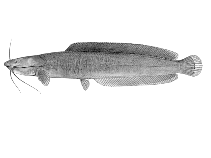
Rückenflossenstacheln (insgesamt) : 0; Rückenflossenweichstrahlen (insgesamt) : 82 - 85; Afterflossenweichstrahlen: 67 - 74; Wirbelzahl: 66 - 69. Diagnosis: head short (Ref. 248), its length 18.3-20.6% SL (Ref. 81644), small and rather rounded in dorsal outline (Ref. 248). Eyes dorsally located; frontal fontanelle extremely short and oval-shaped; occipital fontanelle oval-shaped; "dermosphenotic" and supraorbital bones joined and well developed (Ref. 248). Tooth plates relatively broad (Ref. 248), width of premaxillary band 26.2-29.7% HL, width of vomerine band 24.5-26.5% HL (Ref. 81644). Pectoral spine slightly curved (Ref. 248), strongly serrated on posterior face, weakly serrated on its anterior face (Ref. 81644). Gill rakers long, slender and distantly set; suprabranchial organ well developed (Ref. 248). Oenings of secondary sensory canals regularly placed along flanks (Ref. 248, 81644).
Body shape (shape guide): elongated; Cross section: circular.
Facultative air-breathing (Ref. 126274); The biology of this species is in the main unknown (Ref. 78218). Maximum size reported is 159mm TL (Ref. 81644).
Lebenszyklus und Paarungsverhalten
Geschlechtsreife | Fortpflanzung | Ablaichen | Eier | Fruchtbarkeit | Larven
Teugels, G.G., 1986. A systematic revision of the African species of the genus Clarias (Pisces; Clariidae). Ann. Mus. R. Afr. Centr., Sci. Zool., 247:199 p. (Ref. 248)
IUCN Rote Liste Status (Ref. 130435: Version 2025-2 (Global))
Bedrohung für Menschen
Harmless
Nutzung durch Menschen
Fischereien: nicht kommerziell
Tools
Zusatzinformationen
Download XML
Internet Quellen
Schätzungen auf der Grundlage von Modellen
Phylogenetischer Diversitätsindex (Ref.
82804): PD
50 = 0.5000 [Uniqueness, from 0.5 = low to 2.0 = high].
Bayesian length-weight: a=0.00776 (0.00372 - 0.01620), b=2.96 (2.79 - 3.13), in cm total length, based on LWR estimates for this Genus-body shape (Ref.
93245).
Trophische Ebene (Ref.
69278): 3.3 ±0.5 se; based on size and trophs of closest relatives
Widerstandsfähigkeit (Ref.
120179): hoch, Verdopplung der Population dauert weniger als 15 Monate. (Preliminary K or Fecundity.).
Anfälligkeit der Fischerei (Ref.
59153): Low vulnerability (10 of 100).
🛈