>
Siluriformes (Catfishes) >
Clariidae (Airbreathing catfishes)
Etymology: Clarias: Greek, chlaros = lively, in reference to the ability of the fish to live for a long time out of water.
More on author: Peters.
Environnement : milieu / zone climatique / profondeur / gamme de distribution
Écologie
; eau douce démersal. Tropical; 4°N - 2°N
Africa: Kribi (Kienke) and Lobé/Lobi in Cameroon (Ref. 248, 78218, 81644), Komo and Ntem in Cameroon
and Gabon, and the Ogowe in Gabon (Ref. 81644). Other reports unconfirmed in Ref. 248, 78218 or 81644, including reports from the rivers Boumba and Lobi (Dja system, middle Congo River basin) in Cameroon (Ref. 51193), Luongo River (upper Congo River basin) in Zambia (Ref. 27609), Zambezi, Chobe and Kwando in Namibia (Ref. 37065) and Ehoma floodplain in Nigeria (Ref. 52861). Reports from the Kasai, Kwango and Kwilu systems in Ref. 11970 refer to Clarias platycephalus, C. angolensis and C. dumerilii (Ref. 114852).
Taille / Poids / Âge
Maturité: Lm ? range ? - ? cm
Max length : 16.0 cm TL mâle / non sexé; (Ref. 3820)
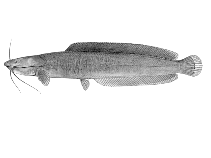
Épines dorsales (Total) : 0; Rayons mous dorsaux (Total) : 82 - 85; Rayons mous anaux: 67 - 74; Vertèbres: 66 - 69. Diagnosis: head short (Ref. 248), its length 18.3-20.6% SL (Ref. 81644), small and rather rounded in dorsal outline (Ref. 248). Eyes dorsally located; frontal fontanelle extremely short and oval-shaped; occipital fontanelle oval-shaped; "dermosphenotic" and supraorbital bones joined and well developed (Ref. 248). Tooth plates relatively broad (Ref. 248), width of premaxillary band 26.2-29.7% HL, width of vomerine band 24.5-26.5% HL (Ref. 81644). Pectoral spine slightly curved (Ref. 248), strongly serrated on posterior face, weakly serrated on its anterior face (Ref. 81644). Gill rakers long, slender and distantly set; suprabranchial organ well developed (Ref. 248). Oenings of secondary sensory canals regularly placed along flanks (Ref. 248, 81644).
Body shape (shape guide): elongated; Cross section: circular.
Facultative air-breathing (Ref. 126274); The biology of this species is in the main unknown (Ref. 78218). Maximum size reported is 159mm TL (Ref. 81644).
Cycle de vie et comportement reproducteur
Maturité | Reproduction | Frai | Œufs | Fécondité | Larves
Teugels, G.G., 1986. A systematic revision of the African species of the genus Clarias (Pisces; Clariidae). Ann. Mus. R. Afr. Centr., Sci. Zool., 247:199 p. (Ref. 248)
Statut dans la liste rouge de l'IUCN (Ref. 130435: Version 2025-2 (Global))
Menace pour l'homme
Harmless
Utilisations par l'homme
Pêcheries: sans intérêt
Outils
Articles particuliers
Télécharger en XML
Sources Internet
Estimations basées sur des modèles
Indice de diversité phylogénétique (Réf.
82804): PD
50 = 0.5000 [Uniqueness, from 0.5 = low to 2.0 = high].
Bayesian length-weight: a=0.00776 (0.00372 - 0.01620), b=2.96 (2.79 - 3.13), in cm total length, based on LWR estimates for this Genus-body shape (Ref.
93245).
Niveau trophique (Réf.
69278): 3.3 ±0.5 se; based on size and trophs of closest relatives
Résilience (Réf.
120179): Haut, temps minimum de doublement de population inférieur à 15 mois (Preliminary K or Fecundity.).
Vulnérabilité de la pêche (Ref.
59153): Low vulnerability (10 of 100).
🛈