>
Cichliformes (Cichlids, convict blennies) >
Cichlidae (Cichlids) > Pseudocrenilabrinae
Etymology: Oreochromis: Latin, aurum = gold + Greek, chromis = a fish, perhaps a perch (Ref. 45335).
More on author: Trewavas.
Ambiente: milieu / zona climatica / distribuzione batimetrica / gamma di distribuzione
Ecologia
; acqua dolce benthopelagico; distribuzione batimetrica 30 - 100 m (Ref. 4967). Tropical; 8°S - 15°S
Africa: Lake Malawi (Ref. 2, 5166, 118630). Reports from Lake Chungruru (Ref. 2, 54852) and Lake Kingiri (Ref. 2, 54852) are misidentifications of Oreochromis chungruruensis and juvenile Oreochromis squamipinnis respectively (Ref. 118638).
Lunghezza alla prima maturità / Dimensione / Peso / Età
Maturità: Lm 29.9, range 24 - 37 cm
Max length : 38.0 cm SL maschio/sesso non determinato; (Ref. 4967)
Breve descrizione
Chiavi di identificazione | Morfologia | Morfometria
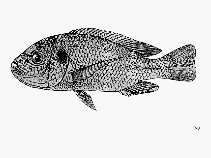
Spine dorsali (totale) : 14 - 17; Raggi dorsali molli (totale) : 10 - 11; Spine anali: 3; Raggi anali molli: 8 - 10; Vertebre: 30 - 32. Diagnosis: breeding male black; length of head 34.4-42.4% SL; length of lower jaw 31.3-40.0% head length (Ref. 2). Teeth of jaw in 3-4, rarely 5 rows (Ref. 2,6150). Lower pharyngeal bone with restricted toothed area; median length of bone 33.0-40.7 % length of head and 1.3-1.5 times its own width; blade 1.9-3.9 times median length of toothed area (Ref. 2).
Body shape (shape guide): fusiform / normal; Cross section: compressed.
Occurs in all kinds of habitats but is mainly found in open water away from the coast (Ref. 5595). The most pelagic of the Lake Malawi Oreochromis species (Ref. 2, 87, 4364, 4916, 4967). Forms schools (Ref. 2, 2781). Feeds on phytoplankton (Ref. 2, 87, 5595, 10402, 42295, 52161). Female mouthbrooder (Ref. 2). It is suspected that Oreochromis lidole is now globally extinct, as it has not been positively recorded since 2007 (Ref. 118638).
Seems to be sexually mature at a smaller size in Lakes Chungruru and Kingiri than in Lake Malawi (Ref. 2, 54852). Spawns off clean sandy or rocky shores (Ref. 2, 87, 2781) in deeper water (Ref. 2, 87, 2781, 5595, 6150, 40193). Territorial males build a large (Ref. 5595, 40193, 55079) sand-castle nest, with a characteristic spawning cone in its center (Ref. 2, 5595). Females congregate in schools that may number hundreds of individuals (Ref. 2, 2781, 5595). The male genital tassel, which develops together with the breeding dress and imitates a clutch of eggs, is dragged through the nest after the females has deposited some eggs, which are picked up immediately; the female probably mistakes the tassel for eggs that have been forgotten and tries to collect them as well, which results in the eggs being fertilized (Ref. 5595). Females carrying eggs in the mouth move into open, more eutrophic waters, and stay there until the young have almost lost the yolk sac; they feed little during this time (Ref. 2781). Females brood eggs/young, guarding their fry until about 52(-58)mm (Ref. 2, 2781). Females move inshore with their young for at least part of the day; the young are spat out to feed, and food (small phytoplankton) is found in the foregut before the involuted yolk-sac is fully absorbed (Ref. 2781).
Trewavas, E. and G.G. Teugels, 1991. Oreochromis. p. 307-346. In J. Daget, J.-P. Gosse, G.G. Teugels and D.F.E. Thys van den Audenaerde (eds.) Checklist of the freshwater fishes of Africa (CLOFFA). ISNB, Brussels; MRAC, Tervuren; and ORSTOM, Paris. Vol. 4. (Ref. 5166)
Stato della Lista Rossa IUCN (Ref. 130435: Version 2025-2 (Global))
Minaccia per l'uomo
Harmless
Usi umani
Pesca: commerciale; Acquario: Commerciale
Strumenti
Rapporti speciali
Scarica XML
Fonti Internet
Stime basate su modelli
Indice di diversità filogenetica (Fonte Biblio.
82804): PD
50 = 0.5000 [Uniqueness, from 0.5 = low to 2.0 = high].
Bayesian length-weight: a=0.01349 (0.00685 - 0.02655), b=2.98 (2.82 - 3.14), in cm total length, based on LWR estimates for this species & Genus-body shape (Ref.
93245).
Livello trofico (Fonte Biblio.
69278): 2.3 ±0.22 se; based on food items.
Resilienza (Fonte Biblio.
120179): Medio, tempo minimo di raddoppiamento della popolazione 1.4 - 4.4 anni (K=0.18-0.52; tm=3).
Vulnerabilità della pesca (Ref.
59153): Moderate to high vulnerability (46 of 100).
🛈
Nutrienti (Ref.
124155): Calcium = 13.5 [5.8, 74.3] mg/100g; Iron = 1.2 [0.5, 2.9] mg/100g; Protein = 17.9 [16.2, 19.7] %; Omega3 = 0.432 [0.150, 1.200] g/100g; Selenium = 95.6 [35.2, 222.7] μg/100g; VitaminA = 21.7 [4.8, 87.9] μg/100g; Zinc = 1.99 [1.08, 4.62] mg/100g (wet weight); based on
nutrient studies.