>
Cichliformes (Cichlids, convict blennies) >
Cichlidae (Cichlids) > Pseudocrenilabrinae
Etymology: Oreochromis: Latin, aurum = gold + Greek, chromis = a fish, perhaps a perch (Ref. 45335).
More on author: Günther.
Miljö: miljö / Klimatzon / djupintervall / distributionsområde
Ekologi
; sötvatten bentopelagisk. Tropical; 9°S - 15°S
Africa: Lake Malawi and its catchment (Ref. 118630), including crater lakes Kingiri, Ilamba and Massoko (Ref. 118638) and Upper Shire River (Ref. 37112).
Längd vid första mognad / Storlek / Vikt / Ålder
Könsmognad: Lm 26.9, range 20 - 37 cm
Max length : 36.0 cm SL hane/ej könsbestämd; (Ref. 4967)
Kort beskrivning
Bestämningsnycklar | Morfologi | Morfometri
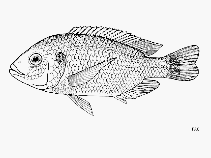
Taggstrålar i ryggfenan (totalt) : 16 - 17; Mjukstrålar i ryggfenan (totalt) : 10 - 11; Taggstrålar i analfenan: 3; Mjukstrålar i analfenan: 8 - 10. Diagnosis: A heavily-built large tilapia species with a wide rounded head; dwarf populations exist in some crater lakes, showing bony 'hunger-form' body shape (Ref. 118638). Females and juveniles with grey bodies and 6 or more vertical bars; males have a bright blue, occasionally white or green, 'mask' across the head; when fully ripe, the underside of most of the body can be black, with the upper surface a conspicuous white to pale blue; genital tassel can be long and branched, pinkish to bright yellow; females and non-territorial males are indistinguishable from Oreochromis karongae (Ref. 118638).
Body shape (shape guide): fusiform / normal; Cross section: compressed.
A semi-pelagic species (Ref. 4967), found in all kinds of habitats but seen mostly in shallow water; it is abundant in the southeastern arm of Lake Malawi, where it occurs in shallow, vegetated bays (Ref. 5595). It feeds on phytoplankton and sometimes from the sediment on the sand; diatoms constitute the major part of its diet (Ref. 5595). Major component of the fisheries catch in Lake Malawi (Ref. 118638). IUCN conservation status is endangered, due to declining population trend (Ref. 118638).
Mating behavior includes the T-stand, both partners alternately forming the horizontal part of the T. Eggs are laid in batches and immediately picked up by the female. Fertilization takes place both on the ground and in the mouth. Females brood eggs/young, guarding their fry until about 15 mm (Ref. 2781).
Trewavas, E., 1983. Tilapiine fishes of the genera Sarotherodon, Oreochromis and Danakilia. British Mus. Nat. Hist., London, UK. 583 p. (Ref. 2)
Status på IUCN:s rödlista (Ref. 130435: Version 2025-2 (Global))
Hot mot människor
Harmless
Mänskliga användningsområden
Fiskeri: kommersiell; Akvarium: Kommersiell
Verktyg
Särskilda rapporter
Ladda ner XML
Internet-källor
Uppskattningar baserade på modeller
Index för fylogenetisk mångfald (Ref.
82804): PD
50 = 0.5000 [Uniqueness, from 0.5 = low to 2.0 = high].
Bayesian length-weight: a=0.01622 (0.00828 - 0.03177), b=3.00 (2.84 - 3.16), in cm total length, based on LWR estimates for this species & Genus-body shape (Ref.
93245).
Trofisk nivå (Ref.
69278): 2.1 ±0.00 se; based on food items.
Resiliens (Ref.
120179): Mellan, lägsta populationsfördubblingstid 1,4-4,4 år (K=0.24-0.45; tm=3).
Sårbarhet i fisket (Ref.
59153): Moderate vulnerability (38 of 100).
🛈
Näringsämnen (Ref.
124155): Calcium = 15.4 [6.5, 81.6] mg/100g; Iron = 1.23 [0.56, 2.94] mg/100g; Protein = 17.9 [16.3, 19.8] %; Omega3 = 0.387 [0.135, 1.078] g/100g; Selenium = 75.2 [28.6, 173.9] μg/100g; VitaminA = 22 [5, 89] μg/100g; Zinc = 2.12 [1.16, 4.98] mg/100g (wet weight);