>
Gadiformes (Cods) >
Gaidropsaridae (Rocklings)
Etymology: Gaidropsarus: Greek, ga, ge = the earth + Greek, ydro = water + Greek psaros = speckled, starling (Ref. 45335).
Taxonomic Remarks
Junior synonym of Gaidropsarus macrophthalmus according to Ref. Barros-Garcia et al., 2022 (Ref. 131625:131).
Environnement : milieu / zone climatique / profondeur / gamme de distribution
Écologie
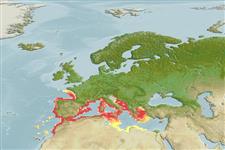
marin benthopélagique; non migrateur; profondeur 80 - 600 m. Temperate; 48°N - 30°N, 18°W - 30°E
Eastern Central Atlantic: western Mediterranean and northern part of central Mediterranean. Also from Spain and Portugal to Morocco and Madeira.
Taille / Poids / Âge
Maturité: Lm ? range ? - ? cm
Max length : 40.0 cm TL mâle / non sexé; (Ref. 1371); common length : 12.0 cm TL mâle / non sexé; (Ref. 1371)
Description synthétique
Clés d'identification | Morphologie | Morphométrie
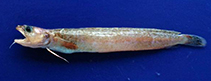
Épines dorsales (Total) : 0; Épines anales: 0. First dorsal spine followed by a few small fleshy filaments. Two fang-like teeth at the symphysis of the upper jaw.
Body shape (shape guide): elongated; Cross section: circular.
Found in offshore waters on mud, shell and coral bottoms. Feed on crustaceans. Spawning occurs in February. Occasionally sold in markets.
Cycle de vie et comportement reproducteur
Maturité | Reproduction | Frai | Œufs | Fécondité | Larves
Svetovidov, A.N., 1986. Review of the three-bearded rocklings of the genus Gaidropsaurus Rafinesque, 1810 (Gadidae) with description of a new species. J. Ichthyol. 26(1)114-135. (Ref. 9985)
Statut dans la liste rouge de l'IUCN (Ref. 130435: Version 2025-2 (Global))
Menace pour l'homme
Harmless
Utilisations par l'homme
Pêcheries: intérêt commercial mineur
Outils
Articles particuliers
Télécharger en XML
Sources Internet
Estimations basées sur des modèles
Température préférée (Réf.
123201): 12.9 - 15, mean 13.9 °C (based on 79 cells).
Indice de diversité phylogénétique (Réf.
82804): PD
50 = 0.5000 [Uniqueness, from 0.5 = low to 2.0 = high].
Bayesian length-weight: a=0.00501 (0.00265 - 0.00947), b=3.04 (2.88 - 3.20), in cm total length, based on LWR estimates for this species & Genus-body shape (Ref.
93245).
Niveau trophique (Réf.
69278): 3.6 ±0.3 se; based on diet studies.
Résilience (Réf.
120179): Milieu, temps minimum de doublement de population : 1,4 à 4,4 années (Preliminary K or Fecundity.).
Vulnérabilité de la pêche (Ref.
59153): Low to moderate vulnerability (30 of 100).
🛈
Nutriments (Ref.
124155): Calcium = 30.4 [13.2, 62.0] mg/100g; Iron = 0.272 [0.138, 0.580] mg/100g; Protein = 16.7 [14.9, 18.5] %; Omega3 = 0.421 [0.207, 0.786] g/100g; Selenium = 22 [10, 51] μg/100g; VitaminA = 18.2 [4.1, 80.3] μg/100g; Zinc = 0.576 [0.384, 0.923] mg/100g (wet weight);