>
Gadiformes (Cods) >
Gaidropsaridae (Rocklings)
Etymology: Gaidropsarus: Greek, ga, ge = the earth + Greek, ydro = water + Greek psaros = speckled, starling (Ref. 45335).
Umwelt: Milieu / Klimazone / Tiefenbereich / Verbreitungsgebiet
Ökologie
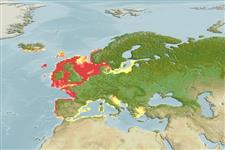
seewasser demersal; standorttreu; tiefenbereich 20 - 120 m (Ref. 35388). Temperate; 64°N - 34°N, 23°W - 27°E
Northeast Atlantic: from Norway and Iceland south to Gibraltar, including Madeira
and Mediterranean.
Größe / Gewicht / Alter
Geschlechtsreife: Lm ? range ? - ? cm
Max length : 60.0 cm TL Männchen/unbestimmt; (Ref. 1371); common length : 25.0 cm TL Männchen/unbestimmt; (Ref. 3397)
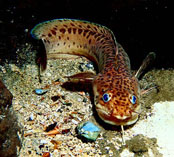
Rückenflossenstacheln (insgesamt) : 0; Afterflossenstacheln: 0. First dorsal ray followed by a row of small, fleshy filaments. Color is varies from dusky to pale. Fin coloration varies geographically in the Western Atlantic, with southern specimens having more dark blotches than northern ones (Ref. 1371). One barbel on the lower jaw and two on the snout. Large chocolate brown spots on head and body (Ref. 35388).
Body shape (shape guide): elongated; Cross section: oval.
Found on rocky bottoms but also on mud, sand and gravel. Feed on shrimps, crabs, isopods, small fish, mollusks and polychaetes (Ref. 1371). Spawn during spring and summer in the Mediterranean. Eggs and larvae are pelagic (Ref. 1371).
Lebenszyklus und Paarungsverhalten
Geschlechtsreife | Fortpflanzung | Ablaichen | Eier | Fruchtbarkeit | Larven
Cohen, D.M., T. Inada, T. Iwamoto and N. Scialabba, 1990. FAO species catalogue. Vol. 10. Gadiform fishes of the world (Order Gadiformes). An annotated and illustrated catalogue of cods, hakes, grenadiers and other gadiform fishes known to date. FAO Fish. Synop. 125(10). Rome: FAO. 442 p. (Ref. 1371)
IUCN Rote Liste Status (Ref. 130435: Version 2025-2 (Global))
Bedrohung für Menschen
Harmless
Nutzung durch Menschen
Fischereien: weniger kommerziell
Tools
Zusatzinformationen
Download XML
Internet Quellen
Schätzungen auf der Grundlage von Modellen
Bevorzugte Temperatur (Ref.
123201): 7.1 - 12.6, mean 9.6 °C (based on 254 cells).
Phylogenetischer Diversitätsindex (Ref.
82804): PD
50 = 0.5000 [Uniqueness, from 0.5 = low to 2.0 = high].
Bayesian length-weight: a=0.00501 (0.00313 - 0.00801), b=3.00 (2.87 - 3.13), in cm total length, based on LWR estimates for this species & Genus-body shape (Ref.
93245).
Trophische Ebene (Ref.
69278): 3.5 ±0.4 se; based on diet studies.
Widerstandsfähigkeit (Ref.
120179): mittel, Verdopplung der Population dauert 1,4 - 4,4 Jahre. (tmax=6).
Anfälligkeit der Fischerei (Ref.
59153): Moderate vulnerability (44 of 100).
🛈
Nährstoffe (Ref.
124155): Calcium = 42.4 [19.9, 94.9] mg/100g; Iron = 0.375 [0.191, 0.788] mg/100g; Protein = 17.5 [15.7, 19.4] %; Omega3 = 0.356 [0.177, 0.686] g/100g; Selenium = 17.9 [9.2, 38.7] μg/100g; VitaminA = 7.64 [1.68, 31.14] μg/100g; Zinc = 0.497 [0.341, 0.757] mg/100g (wet weight);