>
Gadiformes (Cods) >
Merlucciidae (Merluccid hakes)
Etymology: Merluccius: Latin, mar, maris = the sea + Latin, lucius = pike (Ref. 45335).
Umwelt: Milieu / Klimazone / Tiefenbereich / Verbreitungsgebiet
Ökologie
seewasser bathydemersal; standorttreu; tiefenbereich 200 - 1000 m (Ref. 6605), usually 400 - ? m (Ref. 58452). Deep-water; 17°S - 38°S, 10°E - 48°E (Ref. 58452)
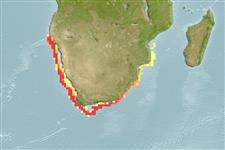
Southeast Atlantic: Cape Frio, Namibia south to the Agulhas Bank and east to East London in South Africa. Western Indian Ocean: Madagascar Ridge (33°S,44°E).
Länge bei der ersten Reifung / Größe / Gewicht / Alter
Geschlechtsreife: Lm 47.8 range ? - ? cm
Max length : 115 cm TL Männchen/unbestimmt; (Ref. 27121); common length : 60.0 cm SL Männchen/unbestimmt; (Ref. 1371)
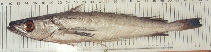
Rückenflossenstacheln (insgesamt) : 1; Rückenflossenweichstrahlen (insgesamt) : 42 - 50; Afterflossenstacheln: 0; Afterflossenweichstrahlen: 38 - 41. Body more slender than other hakes. Head large, about 25 to 30% of SL. Gill rakers short and thick with blunt tips. Pectoral fin tips reaching to level of anal fin origin. Color is steel gray on back, grading to silvery white ventrally.
Body shape (shape guide): elongated; Cross section: oval.
Found near the bottom. Feeds on fishes, mysids, euphausiids and squids. Young feed mainly on euphausiids, but the diet becomes polyphagous with growth. Cannibalism has been observed in larger individuals (Ref. 9583).
Lebenszyklus und Paarungsverhalten
Geschlechtsreife | Fortpflanzung | Ablaichen | Eier | Fruchtbarkeit | Larven
Cohen, D.M., T. Inada, T. Iwamoto and N. Scialabba, 1990. FAO species catalogue. Vol. 10. Gadiform fishes of the world (Order Gadiformes). An annotated and illustrated catalogue of cods, hakes, grenadiers and other gadiform fishes known to date. FAO Fish. Synop. 125(10). Rome: FAO. 442 p. (Ref. 1371)
IUCN Rote Liste Status (Ref. 130435: Version 2025-2 (Global))
Bedrohung für Menschen
Harmless
Nutzung durch Menschen
Fischereien: hoch kommerziell
Tools
Zusatzinformationen
Download XML
Internet Quellen
Schätzungen auf der Grundlage von Modellen
Bevorzugte Temperatur (Ref.
123201): 6.2 - 12, mean 7.5 °C (based on 17 cells).
Phylogenetischer Diversitätsindex (Ref.
82804): PD
50 = 0.5000 [Uniqueness, from 0.5 = low to 2.0 = high].
Bayesian length-weight: a=0.00525 (0.00300 - 0.00918), b=3.09 (2.94 - 3.24), in cm total length, based on LWR estimates for this species & Genus-body shape (Ref.
93245).
Trophische Ebene (Ref.
69278): 3.8 ±0.2 se; based on diet studies.
Widerstandsfähigkeit (Ref.
120179): niedrig, Verdopplung der Population dauert 4,5 - 14 Jahre. (K=0.09-0.12).
Anfälligkeit der Fischerei (Ref.
59153): High to very high vulnerability (65 of 100).
🛈
Klimaanfälligkeit (Ref.
125649): High vulnerability (55 of 100).
🛈
Nährstoffe (Ref.
124155): Calcium = 7.36 [3.59, 25.05] mg/100g; Iron = 0.274 [0.058, 0.735] mg/100g; Protein = 17.3 [16.1, 18.5] %; Omega3 = 0.146 [0.078, 0.273] g/100g; Selenium = 28 [13, 66] μg/100g; VitaminA = 11.7 [2.4, 55.4] μg/100g; Zinc = 0.186 [0.127, 0.288] mg/100g (wet weight);