>
Stomiiformes (Lightfishes and dragonfishes) >
Stomiidae (Barbeled dragonfishes) > Chauliodontinae
Etymology: Chauliodus: Greek, chaulios, chaulos, chaunos = to be with the mouth opened + Greek, odous = teeth (Ref. 45335).
Eponymy: Sir Hans Sloane (1660–1753) was a physician and avid collector. [...] (Ref. 128868), visit book page.
More on authors: Bloch & Schneider.
Entorno: milieu / zona climática / rango de profundidad / gama de distribución
Ecología
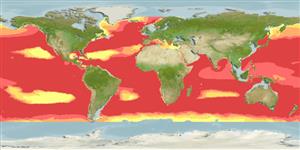
marino batipelágico; rango de profundidad 200 - 4700 m (Ref. 74511), usually 494 - 1000 m (Ref. 28981). Deep-water; 70°N - 56°S, 180°W - 180°E
Warm and temperate parts of all oceans but with several distributional gaps in the southern central Atlantic, northern Indian Ocean, eastern Pacific north of the equator, etc. Also found in the western Mediterranean (Ref. 4759). South China Sea and East China Sea (Ref.74511).
Tamaño / Peso / Edad
Madurez: Lm ? range ? - ? cm
Max length : 35.0 cm SL macho / no sexado; (Ref. 559)
Descripción breve
Claves de identificación | Morfología | Morfometría
Espinas dorsales (total) : 0; Radios blandos dorsales (total) : 5 - 8; Espinas anales: 0; Radios blandos anales: 10 - 13. Body iridescent silver in color (Ref. 3981). Slender body, forward position of dorsal fin and greater number of serial photophores (Ref. 37473).
Body shape (shape guide): elongated.
Inhabits deep oceanic waters to more than 1,000 m depth; may migrate to near-surface waters at night (Ref. 4759). Up to depth of 1800 m (Ref. 47377). Depth range 473-1192 m in the eastern Ionian Sea (Ref. 56504). Meso- and bathypelagic from near the surface to 2800 m (Ref. 58302). Oviparous (Ref. 5951). Feeds on midwater fishes and crustaceans (Ref. 4759); mainly on myctophids (Ref. 5951). Lipid content is 2.4 % in fresh body weight and wax ester is 7.2 % in total lipids (Ref. 9193). Minimum depth from Ref. 58018.
Ciclo vital y comportamiento de apareamiento
Madurez | Reproducción | Puesta | Huevos | Fecundidad | Larva
Gibbs, R.H. Jr., 1984. Chauliodontidae. p. 336-337. In P.J.P. Whitehead, M.-L. Bauchot, J.-C. Hureau, J. Nielsen and E. Tortonese (eds.) Fishes of the north-eastern Atlantic and the Mediterranean. UNESCO, Paris. Vol. 1. (Ref. 4759)
Situación en la Lista Roja de la UICN (Ref. 130435: Version 2025-2 (Global))
Amenaza para el ser humano
Harmless
Usos humanos
Pesquerías: bycatch
Herramientas
Informes especiales
Descargar XML
Fuentes de Internet
Estimaciones basadas en modelos
Temperatura preferida (Referencia
123201): 2.8 - 11.4, mean 6.4 °C (based on 1838 cells).
Índice de diversidad filogenética (Referencia
82804): PD
50 = 0.5020 [Uniqueness, from 0.5 = low to 2.0 = high].
Bayesian length-weight: a=0.00117 (0.00089 - 0.00155), b=3.12 (3.04 - 3.20), in cm total length, based on LWR estimates for this species (Ref.
93245).
Nivel trófico (Referencia
69278): 4.2 ±0.7 se; based on diet studies.
Resiliencia (Referencia
120179): Medio, población duplicada en un tiempo mínimo de 1.4-4.4 años (Preliminary K or Fecundity.).
Vulnerabilidad pesquera (Ref.
59153): Low to moderate vulnerability (33 of 100).
🛈
Nutrientes (Ref.
124155): Calcium = 15.9 [4.0, 64.8] mg/100g; Iron = 0.365 [0.113, 1.146] mg/100g; Protein = 2.93 [0.00, 6.84] %; Omega3 = 0.19 [0.06, 0.64] g/100g; Selenium = 13.4 [4.1, 54.1] μg/100g; VitaminA = 45.3 [5.7, 367.3] μg/100g; Zinc = 0.44 [0.20, 1.07] mg/100g (wet weight);