>
Carangiformes (Jacks) >
Carangidae (Jacks and pompanos) > Trachinotinae
Etymology: Trachinotus: Greek, trachys, -eia, -ys = rough + Greek,noton = back (Ref. 45335).
More on author: Linnaeus.
Ambiente: milieu / zona climatica / distribuzione batimetrica / gamma di distribuzione
Ecologia
marino; salmastro pelagic-neritic; distribuzione batimetrica 50 - 200 m (Ref. 27000). Subtropical; 66°N - 13°S, 19°W - 36°E
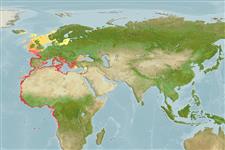
Eastern Atlantic: Bay of Biscay, British and Scandinavian waters (rare vagrant) to Angola, including the Mediterranean Sea and offshore islands.
Dimensione / Peso / Età
Maturità: Lm ? range ? - ? cm
Max length : 70.0 cm TL maschio/sesso non determinato; (Ref. 57392); common length : 35.0 cm NG maschio/sesso non determinato; (Ref. 26999); peso massimo pubblicato: 2.8 kg (Ref. 27584)
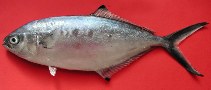
Spine dorsali (totale) : 7; Raggi dorsali molli (totale) : 23 - 27; Spine anali: 3; Raggi anali molli: 22 - 25. Diagnosis: body moderately long (its depth 2.6-3.5 times in fork length) (Ref. 57392, 81654) and compressed (Ref. 57392). Upper jaw very narrow at posterior end and extending only to below anterior third of eye; 22-32 gill rakers on lower limb of first gill arch (Ref. 57392). Tongue with small band of teeth (Ref. 81654). 2 dorsal fins, 1st with 6 spines, 2nd with 1 spine and 23-27 soft rays; anal fin with 2 detached spines followed by 1 spine and 22-25 soft rays (Ref. 57392, 81654). Lobes of soft dorsal and anal fins small (Ref. 57392), dorsal fin lobe 3.9-5.6 times in fork length (Ref. 81654). Length of second dorsal fin base equal to length of anal fin base (Ref. 35388). 2nd dorsal-fin lobe and pectoral fins shorter than head; scales small, cycloid, partially embedded in skin; lateral line very slightly arched over pectoral fins, straight thereafter, and without scutes (Ref. 57392). 3-5 black spots along anterior half of lateral line(Ref. 35388, 57392, 81654).
Coloration: back greenish-grey, sides silvery with 3-5 vertically elongate black spots on anterior half of lateral line; dorsal-, anal- and caudal-fin lobes black-tipped (Ref. 57392).
Body shape (shape guide): fusiform / normal.
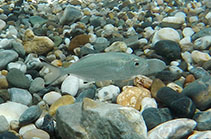
Adults are moderately common in shallow water in areas of surge. Found in clear waters (Ref. 27584), over sand or mud bottoms (Ref. 27000, 57392). Occasionally enters lagoons and river estuaries (Ref. 57392). Form schools (Ref. 27584, 57392). Small specimens are regularly caught at night from steep rocky shores. Adults feed on small crustaceans, mollusks and fishes (Ref. 4233). Eggs are pelagic (Ref. 4233).
Ciclo vitale e comportamento di accoppiamento
Maturità | Riproduzione | Deposizione | Uova | Fecondità | Larve
Smith-Vaniz, W.F., 1986. Carangidae. p. 815-844. In P.J.P. Whitehead, M.-L. Bauchot, J.-C. Hureau, J. Nielsen and E. Tortonese (eds.) Fishes of the north-eastern Atlantic and the Mediterranean. UNESCO, Paris. vol. 2. (Ref. 4233)
Stato della Lista Rossa IUCN (Ref. 130435: Version 2025-2 (Global))
Minaccia per l'uomo
Harmless
Usi umani
Pesca: scarso interesse commerciale; Acquacoltura: commerciale; Pesce da pesca sportiva: si
Strumenti
Rapporti speciali
Scarica XML
Fonti Internet
Stime basate su modelli
Temperatura preferita (Fonte Biblio.
123201): 9.8 - 17.3, mean 13.9 °C (based on 181 cells).
Indice di diversità filogenetica (Fonte Biblio.
82804): PD
50 = 0.5000 [Uniqueness, from 0.5 = low to 2.0 = high].
Bayesian length-weight: a=0.01122 (0.00816 - 0.01542), b=2.89 (2.80 - 2.98), in cm total length, based on LWR estimates for this species (Ref.
93245).
Livello trofico (Fonte Biblio.
69278): 4.2 ±0.7 se; based on diet studies.
Resilienza (Fonte Biblio.
120179): Medio, tempo minimo di raddoppiamento della popolazione 1.4 - 4.4 anni (Preliminary K or Fecundity.).
Prior r = 0.57, 95% CL = 0.37 - 0.85, Based on 1 data-limited stock assessment.
Vulnerabilità della pesca (Ref.
59153): Moderate to high vulnerability (48 of 100).
🛈
Vulnerabilità climatica (Ref.
125649): Low to moderate vulnerability (33 of 100).
🛈
Nutrienti (Ref.
124155): Calcium = 70.6 [42.5, 151.8] mg/100g; Iron = 1.64 [0.98, 3.00] mg/100g; Protein = 19.9 [17.9, 22.0] %; Omega3 = 0.444 [0.285, 0.726] g/100g; Selenium = 25.1 [14.2, 43.3] μg/100g; VitaminA = 13.1 [4.3, 35.8] μg/100g; Zinc = 0.739 [0.525, 1.025] mg/100g (wet weight);