>
Eupercaria/misc (Various families in series Eupercaria) >
Labridae (Wrasses) > Labrinae
Etymology: Symphodus: Greek, syn, symphysis = grown together + Greek, odous = teeth (Ref. 45335).
Eponymy: Clément Honoré Claude Roissal (also spelt Roassal) (1781–1850) was a close friend of the author, Risso, and an amateur artist. Both Risso and Roissal came from Nice (now in France, but then in the Duchy of Savoy). (Ref. 128868), visit book page.
More on author: Risso.
Umwelt: Milieu / Klimazone / Tiefenbereich / Verbreitungsgebiet
Ökologie
seewasser; brackwasser riff-verbunden; tiefenbereich 1 - 30 m (Ref. 4742). Subtropical; 48°N - 30°N, 10°W - 42°E
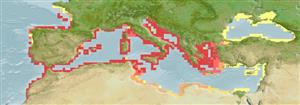
Eastern Atlantic: Gulf of Gascogne to Gibraltar including the Mediterranean and Black Sea.
Länge bei der ersten Reifung / Größe / Gewicht / Alter
Geschlechtsreife: Lm 6.0, range 5 - 7 cm
Max length : 17.0 cm SL Männchen/unbestimmt; (Ref. 4742); common length : 12.0 cm SL Männchen/unbestimmt; (Ref. 4742); max. veröff. Alter: 8 Jahre (Ref. 4742)
Kurzbeschreibung
Bestimmungsschlüssel | Morphologie | Morphometrie
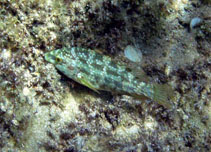
Adults are found near rocks, mainly in eel-grass beds (Ref. 4742). Mainly solitary (Ref. 4742). Nest of seaweed built by male (Ref. 4742). Feed on mollusks, bivalves, gastropods, shrimps, sea-urchins and hydroids (Ref. 4742). Males grow faster than females (Ref. 4742). Oviparous, distinct pairing during breeding (Ref. 205).
Oviparous, distinct pairing during breeding (Ref. 205). Each male builds a nest of seaweed for one or two females to spawn in (Ref. 4742).
Quignard, J.-P. and A. Pras, 1986. Labridae. p. 919-942. In P.J.P. Whitehead, M.-L. Bauchot, J.-C. Hureau, J. Nielsen and E. Tortonese (eds.) Fishes of the north-eastern Atlantic and the Mediterranean. UNESCO, Paris. Vol. 2. (Ref. 4742)
IUCN Rote Liste Status (Ref. 130435: Version 2025-2 (Global))
Bedrohung für Menschen
Harmless
Nutzung durch Menschen
Fischereien: kleinfischerei; Aquarium: Kommerziell
Tools
Zusatzinformationen
Download XML
Internet Quellen
Schätzungen auf der Grundlage von Modellen
Bevorzugte Temperatur (Ref.
123201): 15.2 - 21, mean 18.7 °C (based on 584 cells).
Phylogenetischer Diversitätsindex (Ref.
82804): PD
50 = 0.5005 [Uniqueness, from 0.5 = low to 2.0 = high].
Bayesian length-weight: a=0.01072 (0.00626 - 0.01833), b=3.01 (2.86 - 3.16), in cm total length, based on LWR estimates for this species & Genus-body shape (Ref.
93245).
Trophische Ebene (Ref.
69278): 3.5 ±0.44 se; based on food items.
Widerstandsfähigkeit (Ref.
120179): mittel, Verdopplung der Population dauert 1,4 - 4,4 Jahre. (K=0.20-0.62; tm=1; tmax=8).
Anfälligkeit der Fischerei (Ref.
59153): Low to moderate vulnerability (31 of 100).
🛈
Nährstoffe (Ref.
124155): Calcium = 45.7 [19.7, 108.6] mg/100g; Iron = 0.634 [0.334, 1.285] mg/100g; Protein = 19.4 [16.5, 21.6] %; Omega3 = 0.25 [0.14, 0.45] g/100g; Selenium = 10.2 [4.5, 20.6] μg/100g; VitaminA = 95.9 [24.4, 445.0] μg/100g; Zinc = 1.31 [0.80, 2.35] mg/100g (wet weight);