>
Ophidiiformes (Cusk eels) >
Bythitidae (Livebearing brotulas)
Etymology: Parabrotula: Greek, para = the side of + Latin, brotula, -ae = little, bud, shoot (Ref. 45335).
Ambiente: milieu / zona climatica / distribuzione batimetrica / gamma di distribuzione
Ecologia
marino batipelagico; distribuzione batimetrica 0 - 3000 m (Ref. 35509). Deep-water
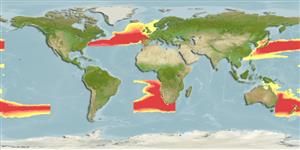
Northeast Atlantic: most of the known specimens from the area (Ref. 36126). Eastern Atlantic: Gulf of Guinea, one specimen 0°42'S, 7°E (Ref. 10800). Southeast Atlantic: off East London, South Africa. Western Pacific: Japan and Australia (Ref. 11228).
Dimensione / Peso / Età
Maturità: Lm ? range ? - ? cm
Max length : 5.4 cm SL maschio/sesso non determinato; (Ref. 35509)
Breve descrizione
Chiavi di identificazione | Morfologia | Morfometria
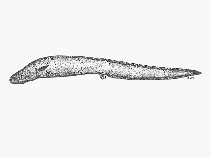
Spine dorsali (totale) : 0; Raggi dorsali molli (totale) : 37 - 41; Spine anali: 0; Raggi anali molli: 34 - 38. Body long, naked and compressed. Skin loose, thin but not gelatinous. Snout pointed. Gill opening large. Head and body uniformly dark brown in alcohol (Ref. 35852).
Found on the continental slope (Ref. 75154). Viviparous (Ref. 10800). Minimum depth from Ref. 58018.
Ciclo vitale e comportamento di accoppiamento
Maturità | Riproduzione | Deposizione | Uova | Fecondità | Larve
Anderson, M.E., 1986. Parabrotulidae. p. 343. In M.M. Smith and P.C. Heemstra (eds.) Smiths' sea fishes. Springer-Verlag, Berlin. (Ref. 6608)
Stato della Lista Rossa IUCN (Ref. 130435: Version 2025-2 (Global))
Minaccia per l'uomo
Harmless
Usi umani
Pesca: bycatch
Strumenti
Rapporti speciali
Scarica XML
Fonti Internet
Stime basate su modelli
Temperatura preferita (Fonte Biblio.
123201): 3.7 - 10.6, mean 6 °C (based on 497 cells).
Indice di diversità filogenetica (Fonte Biblio.
82804): PD
50 = 0.7500 [Uniqueness, from 0.5 = low to 2.0 = high].
Bayesian length-weight: a=0.00102 (0.00046 - 0.00225), b=3.06 (2.88 - 3.24), in cm total length, based on all LWR estimates for this body shape (Ref.
93245).
Livello trofico (Fonte Biblio.
69278): 3.2 ±0.5 se; based on size and trophs of closest relatives
Resilienza (Fonte Biblio.
120179): Basso, tempo minimo di raddoppiamento della popolazione 4.5 - 14 anni (Assuming Fec<100).
Vulnerabilità della pesca (Ref.
59153): Low vulnerability (10 of 100).
🛈