>
Gobiiformes (Gobies) >
Gobiidae (Gobies) > Gobiinae
Etymology: Elacatinus: Greek, elakatines = fusiform fishes preserved in salt (Ref. 45335).
Eponymy: Evelyn McCutcheon née Shaw (1894–1977) was a writer, psychologist and ichthyologist. [...] (Ref. 128868), visit book page.
More on authors: Böhlke & Robins.
Umwelt: Milieu / Klimazone / Tiefenbereich / Verbreitungsgebiet
Ökologie
seewasser riff-verbunden; standorttreu (Ref. 52884); tiefenbereich 1 - 53 m (Ref. 9710), usually 1 - 50 m (Ref. 27115). Tropical; 22°C - 27°C (Ref. 27115)
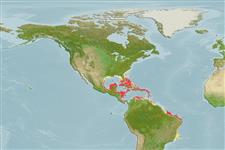
Western Atlantic: Bahamas and the Lesser Antilles to the northern coast of South America. Also Antilles and western Caribbean (Ref. 26938).
Größe / Gewicht / Alter
Geschlechtsreife: Lm ? range ? - ? cm
Max length : 4.0 cm TL Männchen/unbestimmt; (Ref. 26340)
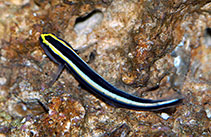
Rückenflossenstacheln (insgesamt) : 7; Rückenflossenweichstrahlen (insgesamt) : 12; Afterflossenstacheln: 1; Afterflossenweichstrahlen: 11 - 12. Yellow stripe in front of each eye, joining near tip of snout to form V. Mouth inferior; snout overhangs upper lip, connected by frenum (Ref. 26938). A black stripe beginning on snout, passing through lower part of eye, across upper end of gill opening onto body where it broadens and continues along lower side to end of caudal fin (Ref. 13442).
Body shape (shape guide): elongated.
Adults inhabit coral reefs with clear waters, preferably in oceanic, insular areas (Ref. 13928). In pairs near coral heads. Monogamous (Ref. 52884). A cleaner (Ref. 9710). Minimum depth reported from Ref. 27115. Have been reared in captivity (Ref. 35420). Adults feed on ectoparasites of fishes (Ref. 13442).
Lebenszyklus und Paarungsverhalten
Geschlechtsreife | Fortpflanzung | Ablaichen | Eier | Fruchtbarkeit | Larven
Monogamous mating is observed as both obigate and social (Ref. 52884).
Böhlke, J.E. and C.C.G. Chaplin, 1993. Fishes of the Bahamas and adjacent tropical waters. 2nd edition. University of Texas Press, Austin. (Ref. 5521)
IUCN Rote Liste Status (Ref. 130435: Version 2025-2 (Global))
Bedrohung für Menschen
Harmless
Nutzung durch Menschen
Fischereien: kommerziell; Aquarium: Kommerziell
Tools
Zusatzinformationen
Download XML
Internet Quellen
Schätzungen auf der Grundlage von Modellen
Bevorzugte Temperatur (Ref.
123201): 24.8 - 28, mean 27.3 °C (based on 360 cells).
Phylogenetischer Diversitätsindex (Ref.
82804): PD
50 = 0.5000 [Uniqueness, from 0.5 = low to 2.0 = high].
Bayesian length-weight: a=0.00741 (0.00347 - 0.01582), b=3.09 (2.91 - 3.27), in cm total length, based on LWR estimates for this (Sub)family-body shape (Ref.
93245).
Trophische Ebene (Ref.
69278): 3.4 ±0.35 se; based on food items.
Widerstandsfähigkeit (Ref.
120179): hoch, Verdopplung der Population dauert weniger als 15 Monate. (Preliminary K or Fecundity.).
Anfälligkeit der Fischerei (Ref.
59153): Low vulnerability (10 of 100).
🛈
Nährstoffe (Ref.
124155): Calcium = 278 [117, 657] mg/100g; Iron = 1.22 [0.55, 2.55] mg/100g; Protein = 17.8 [15.7, 19.6] %; Omega3 = 0.112 [0.043, 0.268] g/100g; Selenium = 34.1 [12.3, 89.3] μg/100g; VitaminA = 122 [29, 501] μg/100g; Zinc = 3.07 [1.80, 4.86] mg/100g (wet weight);