>
Clupeiformes (Herrings) >
Dorosomatidae (Gizzard shads and sardinellas)
Etymology: Tenualosa: Latin, tenuis = thin + Latin, alausa = a fish cited by Ausonius and Latin, halec = pickle, dealing with the Greek word hals = salt; it is also the old Saxon name for shad = "alli" ; 1591 (Ref. 45335).
More on author: Bleeker.
Окружающая среда: среда / климатическая зона / пределы глубины / диапазон распространения
экология
морской; пресноводный; солоноватоводный pelagic-neritic; анадромный (Ref. 51243); пределы глубины 0 - 50 m (Ref. 188). Tropical; 7°N - 9°S, 101°E - 119°E (Ref. 188)
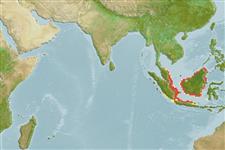
Western Central Pacific: Malaysia, Indonesia (Java Sea and Sarawak, also affluent rivers) and Thailand (southern tip).
Размер / Вес / Возраст
половая зрелость: Lm ? range ? - ? cm
Max length : 52.0 cm SL самец/пол неопределен; (Ref. 188)
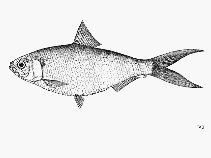
колючие лучи спинного плавника (общее число) : 0; колючие лучи анального плавника: 0. Body moderately deep, belly with 30 to 31 scutes. A median notch on upper jaw distinguishes it from other similar clupeids, except Hilsa kelee. Gill rakers fine but not numerous. Caudal fin long, the lobes long and pointed. No series of dark spots along flank. Resembles T. toli, which has longer head but shorter tail; T. reevesii has many more lower gill rakers and a larger head.
Body shape (shape guide): fusiform / normal; Cross section: compressed.
Schooling in coastal waters and ascending rivers to breed. Feeds on zooplankton (Ref. 58784). Presumably its biology is similar to that of T. ilisha, but the fewer gillrakers suggest that it takes larger food organisms. A protandrous hermaphrodite (Ref. 55367).
Жизненный цикл и брачное поведение
половая зрелость | размножение | нерест | икра | Плодовитость | личинки
A monandric species (Ref. 55367). Sex change occurs at a length of 19.0 cm TL and 0.9 year of age (Ref. 55367).
Whitehead, P.J.P., 1985. FAO Species Catalogue. Vol. 7. Clupeoid fishes of the world (suborder Clupeoidei). An annotated and illustrated catalogue of the herrings, sardines, pilchards, sprats, shads, anchovies and wolf-herrings. FAO Fish. Synop. 125(7/1):1-303. Rome: FAO. (Ref. 188)
Статус Красного Списка МСОП (Ref. 130435: Version 2025-2 (Global))
Угроза для людей
Harmless
Использование человеком
рыболовство: коммерческий
дополнительная информация
инструменты
Специальные отчеты
Скачать в формате XML
ресурсы в Интернет
Оценки, основанные на моделях
Предпочтительная температура (ссылка
123201): 28.2 - 29.1, mean 28.8 °C (based on 266 cells).
Индекс филогенетического разнообразия (ссылка
82804): PD
50 = 0.5312 [Uniqueness, from 0.5 = low to 2.0 = high].
Bayesian length-weight: a=0.00871 (0.00414 - 0.01834), b=3.06 (2.89 - 3.23), in cm total length, based on LWR estimates for this (Sub)family-body shape (Ref.
93245).
Трофический уровень (ссылка
69278): 2.7 ±0.1 se; based on size and trophs of closest relatives
устойчивость к внешним воздействиям (ссылка
120179): высокий, минимальное время удвоения популяции до 15 месяцев (Assuming fec >10,000).
Уязвимость рыбной ловли (Ref.
59153): Moderate to high vulnerability (45 of 100).
🛈
Питательные вещества (Ref.
124155): Calcium = 90 [66, 133] mg/100g; Iron = 2.46 [1.40, 4.15] mg/100g; Protein = 17.3 [16.5, 18.2] %; Omega3 = 0.586 [0.280, 1.275] g/100g; Selenium = 45.7 [18.3, 113.8] μg/100g; VitaminA = 14.1 [4.7, 42.9] μg/100g; Zinc = 1.11 [0.70, 1.89] mg/100g (wet weight); based on
nutrient studies.