>
Clupeiformes (Herrings) >
Dorosomatidae (Gizzard shads and sardinellas)
Etymology: Tenualosa: Latin, tenuis = thin + Latin, alausa = a fish cited by Ausonius and Latin, halec = pickle, dealing with the Greek word hals = salt; it is also the old Saxon name for shad = "alli" ; 1591 (Ref. 45335).
More on author: Bleeker.
Umwelt: Milieu / Klimazone / Tiefenbereich / Verbreitungsgebiet
Ökologie
seewasser; süßwasser; brackwasser pelagic-neritic; anadrom (Ref. 51243); tiefenbereich 0 - 50 m (Ref. 188). Tropical; 7°N - 9°S, 101°E - 119°E (Ref. 188)
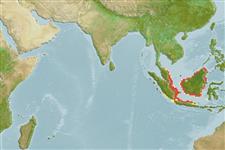
Western Central Pacific: Malaysia, Indonesia (Java Sea and Sarawak, also affluent rivers) and Thailand (southern tip).
Größe / Gewicht / Alter
Geschlechtsreife: Lm ? range ? - ? cm
Max length : 52.0 cm SL Männchen/unbestimmt; (Ref. 188)
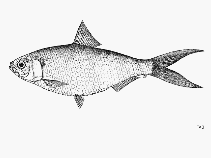
Rückenflossenstacheln (insgesamt) : 0; Afterflossenstacheln: 0. Body moderately deep, belly with 30 to 31 scutes. A median notch on upper jaw distinguishes it from other similar clupeids, except Hilsa kelee. Gill rakers fine but not numerous. Caudal fin long, the lobes long and pointed. No series of dark spots along flank. Resembles T. toli, which has longer head but shorter tail; T. reevesii has many more lower gill rakers and a larger head.
Body shape (shape guide): fusiform / normal; Cross section: compressed.
Schooling in coastal waters and ascending rivers to breed. Feeds on zooplankton (Ref. 58784). Presumably its biology is similar to that of T. ilisha, but the fewer gillrakers suggest that it takes larger food organisms. A protandrous hermaphrodite (Ref. 55367).
Lebenszyklus und Paarungsverhalten
Geschlechtsreife | Fortpflanzung | Ablaichen | Eier | Fruchtbarkeit | Larven
A monandric species (Ref. 55367). Sex change occurs at a length of 19.0 cm TL and 0.9 year of age (Ref. 55367).
Whitehead, P.J.P., 1985. FAO Species Catalogue. Vol. 7. Clupeoid fishes of the world (suborder Clupeoidei). An annotated and illustrated catalogue of the herrings, sardines, pilchards, sprats, shads, anchovies and wolf-herrings. FAO Fish. Synop. 125(7/1):1-303. Rome: FAO. (Ref. 188)
IUCN Rote Liste Status (Ref. 130435: Version 2025-2 (Global))
Bedrohung für Menschen
Harmless
Nutzung durch Menschen
Fischereien: kommerziell
Tools
Zusatzinformationen
Download XML
Internet Quellen
Schätzungen auf der Grundlage von Modellen
Bevorzugte Temperatur (Ref.
123201): 28.2 - 29.1, mean 28.8 °C (based on 266 cells).
Phylogenetischer Diversitätsindex (Ref.
82804): PD
50 = 0.5312 [Uniqueness, from 0.5 = low to 2.0 = high].
Bayesian length-weight: a=0.00871 (0.00414 - 0.01834), b=3.06 (2.89 - 3.23), in cm total length, based on LWR estimates for this (Sub)family-body shape (Ref.
93245).
Trophische Ebene (Ref.
69278): 2.7 ±0.1 se; based on size and trophs of closest relatives
Widerstandsfähigkeit (Ref.
120179): hoch, Verdopplung der Population dauert weniger als 15 Monate. (Assuming fec >10,000).
Anfälligkeit der Fischerei (Ref.
59153): Moderate to high vulnerability (45 of 100).
🛈
Nährstoffe (Ref.
124155): Calcium = 90 [66, 133] mg/100g; Iron = 2.46 [1.40, 4.15] mg/100g; Protein = 17.3 [16.5, 18.2] %; Omega3 = 0.586 [0.280, 1.275] g/100g; Selenium = 45.7 [18.3, 113.8] μg/100g; VitaminA = 14.1 [4.7, 42.9] μg/100g; Zinc = 1.11 [0.70, 1.89] mg/100g (wet weight); based on
nutrient studies.