>
Clupeiformes (Herrings) >
Alosidae (Shads and Sardines)
Etymology: Brevoortia: From James Carson Brevoort (1818-1887), studie the fauna from Ohio and South Caroline (Ref. 45335).
Eponymy: James Carson Brevoort (1818–1887) was an American collector of coins and rare books. [...] Dr Hugh McCormick Smith (1865–1941) was an American physician (1888) who became an ichthyologist. [...] (Ref. 128868), visit book page.
More on author: Hildebrand.
Umwelt: Milieu / Klimazone / Tiefenbereich / Verbreitungsgebiet
Ökologie
seewasser; brackwasser pelagic-neritic; tiefenbereich 0 - 50 m (Ref. 188). Subtropical; 37°N - 23°N, 92°W - 74°W (Ref. 188)
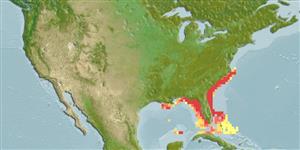
Western Central Atlantic: Beaufort, North Carolina, to Indian River, Florida; Gulf of Mexico (Florida Bay to Louisiana, with possible break between Biscayne Bay and Florida Bay) (Ref. 188). Hybridize with B. tyrannus and B. patronus (Ref. 84218).
Größe / Gewicht / Alter
Geschlechtsreife: Lm ? range ? - ? cm
Max length : 33.0 cm SL Männchen/unbestimmt; (Ref. 37032); common length : 20.0 cm SL Männchen/unbestimmt; (Ref. 188)
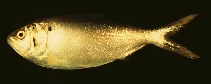
Rückenflossenstacheln (insgesamt) : 0; Afterflossenstacheln: 0. Scutes apparent along belly; upper jaw with median notch. Pelvic fin with oblique and almost straight hind margin, the inner fin rays markedly shorter than outer fin rays when fin folded back. Pre-dorsal scales modified; scales in lateral series small and numerous, those on back and above anal fin markedly smaller than rest. A black spot behind gill opening, but none along flank (Ref. 188). Silvery, with a greenish or bluish back. Fins golden yellow (Ref. 7251).
Body shape (shape guide): fusiform / normal; Cross section: compressed.
A schooling species (but perhaps not in the northern part of its range) occurring inshore and in bays and estuaries. Feeds by filtering phytoplankton. Breeds in winter, probably November through to February or March. Eggs and larvae are planktonic (Ref. 188). Parasitic copepod found in the stomach (Ref. 37032).
Lebenszyklus und Paarungsverhalten
Geschlechtsreife | Fortpflanzung | Ablaichen | Eier | Fruchtbarkeit | Larven
Breeds in winter (eggs and larvae in plankton), probably November through to February or March (no data from Gulf of Mexico).
Whitehead, P.J.P., 1985. FAO Species Catalogue. Vol. 7. Clupeoid fishes of the world (suborder Clupeoidei). An annotated and illustrated catalogue of the herrings, sardines, pilchards, sprats, shads, anchovies and wolf-herrings. FAO Fish. Synop. 125(7/1):1-303. Rome: FAO. (Ref. 188)
IUCN Rote Liste Status (Ref. 130435: Version 2025-2 (Global))
Bedrohung für Menschen
Harmless
Nutzung durch Menschen
Fischereien: weniger kommerziell
Tools
Fatal error: Uncaught mysqli_sql_exception: Too many connections in /var/www/html/includes/speciessummary.lib.php:1888
Stack trace:
#0 /var/www/html/includes/speciessummary.lib.php(1888): mysqli->__construct('mysql', 'fbuser', Object(SensitiveParameterValue), 'fbquizv2', '3306')
#1 /var/www/html/summary/SpeciesSummary.php(1851): checkRecordDisplayFBQuizV2('1591', 'PicList')
#2 {main}
thrown in /var/www/html/includes/speciessummary.lib.php on line 1888