>
Clupeiformes (Herrings) >
Alosidae (Shads and Sardines)
Etymology: Brevoortia: From James Carson Brevoort (1818-1887), studie the fauna from Ohio and South Caroline (Ref. 45335).
Eponymy: James Carson Brevoort (1818–1887) was an American collector of coins and rare books. [...] (Ref. 128868), visit book page.
More on author: Goode.
Ambiente: milieu / zona climática / intervalo de profundidade / gama de distribuição
Ecologia
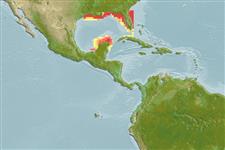
marinhas pelagic-neritic; intervalo de profundidade 0 - 50 m (Ref. 188). Subtropical; 31°N - 19°N, 95°W - 80°W (Ref. 54290)
Western Central Atlantic: Gulf of Mexico (Florida Bay, Gulf of Campeche, Mexico), but no certain records from Caribbean.
Comprimento na primeira maturidade / Tamanho / Peso / Idade
Maturidade: Lm 18.5, range 15 - 22.5 cm
Max length : 35.0 cm SL macho/indeterminado; (Ref. 7251); common length : 20.0 cm SL macho/indeterminado; (Ref. 188)
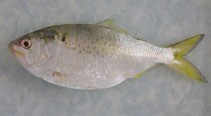
Espinhos dorsais (total) : 0; Espinhos anais: 0. Scutes along belly; upper jaw with median notch. Pelvic fin with rounded hind margin, inner fin rays equal or nearly equal to outer fin rays when fin folded back. Pre-dorsal scales modified; scales in lateral series large, those on back and above anal fin base a little smaller and more irregular than rest. A black spot behind gill opening, followed by a series of spots along flank (Ref. 188). Back bluish gray, Sides brassy green (Ref. 37032).
Body shape (shape guide): fusiform / normal; Cross section: compressed.
Occur inshore in summer, but at least some moving into deeper waters from October (Mississippi Delta area). Feed in dense schools, filtering phytoplankton, but probably also feed at the bottom. Apparently breed in winter (October to February, with a peak in January). Salinity tolerance range from 0.1-60 ppt, but the commercial catch is mostly from 5.0-24 ppt. Marketed fresh, salted or canned. Mainly used as source of fish oil; also as fish meal (Ref. 188). Isopod is found in the mouth (Ref. 37032).
Make inshore-offshore movements (Ref. 34923). Larvae stay in offshore waters for 3-5 weeks before moving into estuaries where they grow into adults (Ref. 34923).
Whitehead, P.J.P., 1985. FAO Species Catalogue. Vol. 7. Clupeoid fishes of the world (suborder Clupeoidei). An annotated and illustrated catalogue of the herrings, sardines, pilchards, sprats, shads, anchovies and wolf-herrings. FAO Fish. Synop. 125(7/1):1-303. Rome: FAO. (Ref. 188)
Categoria na Lista Vermelha da IUCN (Ref. 130435: Version 2025-2 (Global))
Ameaça para o homem
Harmless
Utilização humana
Pescarias: altamente comercial
Ferramentas
Relatórios especiais
Descarregue XML
Fontes da internet
Estimativas baseadas em modelos
Temperatura preferida (Ref.
123201): 23.2 - 26.8, mean 24.3 °C (based on 178 cells).
Índice de diversidade filogenética (Ref.
82804): PD
50 = 0.5156 [Uniqueness, from 0.5 = low to 2.0 = high].
Bayesian length-weight: a=0.00871 (0.00540 - 0.01405), b=3.14 (3.00 - 3.28), in cm total length, based on LWR estimates for this species & (Sub)family-body (Ref.
93245).
Nível Trófico (Ref.
69278): 2.2 ±0.07 se; based on food items.
Generation time: 2.6 (2.2 - 3.0) years. Estimated as median ln(3)/K based on 33
growth studies.
Resiliência (Ref.
120179): Médio, tempo mínimo de duplicação da população 1,4 - 4,4 anos (K=0.15-0.47).
Prior r = 0.62, 95% CL = 0.41 - 0.92, Based on 1 full stock assessment.
Vulnerabilidade da pesca (Ref.
59153): Low to moderate vulnerability (31 of 100).
🛈
Vulnerabilidade climática (Ref.
125649): High to very high vulnerability (74 of 100).
🛈
Nutrientes (Ref.
124155): Calcium = 109 [57, 187] mg/100g; Iron = 1.58 [0.86, 2.78] mg/100g; Protein = 19.1 [17.9, 20.3] %; Omega3 = 0.485 [0.287, 0.818] g/100g; Selenium = 20.8 [11.2, 43.8] μg/100g; VitaminA = 11.3 [3.3, 33.9] μg/100g; Zinc = 1.17 [0.80, 1.68] mg/100g (wet weight);