>
Clupeiformes (Herrings) >
Alosidae (Shads and Sardines)
Etymology: Brevoortia: From James Carson Brevoort (1818-1887), studie the fauna from Ohio and South Caroline (Ref. 45335).
Eponymy: James Carson Brevoort (1818–1887) was an American collector of coins and rare books. [...] (Ref. 128868), visit book page.
More on author: Goode.
Περιβάλλον: περιβάλλον / κλιματική ζώνη / εύρος βάθους / εύρος διανομής
Οικολογία
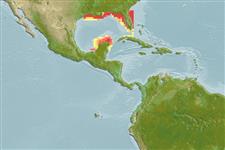
Θαλασσινό(ά) pelagic-neritic; εύρος βάθους 0 - 50 m (Ref. 188). Subtropical; 31°N - 19°N, 95°W - 80°W (Ref. 54290)
Western Central Atlantic: Gulf of Mexico (Florida Bay, Gulf of Campeche, Mexico), but no certain records from Caribbean.
Μήκος κατά την πρώτη ωρίμανση / Μέγεθος / Βάρος / Ηλικία
Γεννητική Ωρίμανση: Lm 18.5, range 15 - 22.5 cm
Max length : 35.0 cm SL αρσενικό/απροσδιόριστο; (Ref. 7251); common length : 20.0 cm SL αρσενικό/απροσδιόριστο; (Ref. 188)
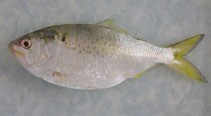
Ραχιαίες άκανθες (συνολικά) : 0; Εδρικές άκανθες: 0. Scutes along belly; upper jaw with median notch. Pelvic fin with rounded hind margin, inner fin rays equal or nearly equal to outer fin rays when fin folded back. Pre-dorsal scales modified; scales in lateral series large, those on back and above anal fin base a little smaller and more irregular than rest. A black spot behind gill opening, followed by a series of spots along flank (Ref. 188). Back bluish gray, Sides brassy green (Ref. 37032).
Body shape (shape guide): fusiform / normal; Cross section: compressed.
Occur inshore in summer, but at least some moving into deeper waters from October (Mississippi Delta area). Feed in dense schools, filtering phytoplankton, but probably also feed at the bottom. Apparently breed in winter (October to February, with a peak in January). Salinity tolerance range from 0.1-60 ppt, but the commercial catch is mostly from 5.0-24 ppt. Marketed fresh, salted or canned. Mainly used as source of fish oil; also as fish meal (Ref. 188). Isopod is found in the mouth (Ref. 37032).
Make inshore-offshore movements (Ref. 34923). Larvae stay in offshore waters for 3-5 weeks before moving into estuaries where they grow into adults (Ref. 34923).
Whitehead, P.J.P., 1985. FAO Species Catalogue. Vol. 7. Clupeoid fishes of the world (suborder Clupeoidei). An annotated and illustrated catalogue of the herrings, sardines, pilchards, sprats, shads, anchovies and wolf-herrings. FAO Fish. Synop. 125(7/1):1-303. Rome: FAO. (Ref. 188)
Κατάσταση Κόκκινου Καταλόγου IUCN (Ref. 130435: Version 2025-2 (Global))
Απειλή για τον άνθρωπο
Harmless
Ανθρώπινες χρήσεις
αλιεία: πολύ εμπορικό
Εργαλεία
Ειδικές εκθέσεις
Λήψη XML
Διαδικτυακές πηγές
Εκτιμήσεις βάσει μοντέλων
Προτιμώμενη θερμοκρασία (Αναφ.
123201): 23.2 - 26.8, mean 24.3 °C (based on 178 cells).
Δείκτης φυλογενετικής ποικιλότητας (Αναφ.
82804): PD
50 = 0.5156 [Uniqueness, from 0.5 = low to 2.0 = high].
Bayesian length-weight: a=0.00871 (0.00540 - 0.01405), b=3.14 (3.00 - 3.28), in cm total length, based on LWR estimates for this species & (Sub)family-body (Ref.
93245).
Τροφικό Επίπεδο (Αναφ.
69278): 2.2 ±0.07 se; based on food items.
Generation time: 2.6 (2.2 - 3.0) years. Estimated as median ln(3)/K based on 33
growth studies.
Ελαστικότητα (Αναφ.
120179): Μεσαίο(α), ελάχιστος χρόνος για διπλασιασμό πληθυσμού 1,4 - 4,4 έτη (K=0.15-0.47).
Prior r = 0.62, 95% CL = 0.41 - 0.92, Based on 1 full stock assessment.
Ευπάθεια στην αλιεία (Ref.
59153): Low to moderate vulnerability (31 of 100).
🛈
Ευπάθεια στο κλίμα (Ref.
125649): High to very high vulnerability (74 of 100).
🛈
Θρεπτικά συστατικά (Ref.
124155): Calcium = 109 [57, 187] mg/100g; Iron = 1.58 [0.86, 2.78] mg/100g; Protein = 19.1 [17.9, 20.3] %; Omega3 = 0.485 [0.287, 0.818] g/100g; Selenium = 20.8 [11.2, 43.8] μg/100g; VitaminA = 11.3 [3.3, 33.9] μg/100g; Zinc = 1.17 [0.80, 1.68] mg/100g (wet weight);