>
Eupercaria/misc (Various families in series Eupercaria) >
Lutjanidae (Snappers) > Lutjaninae
Etymology: Lutjanus: Malay, ikan lutjan, name of a fish.
Milieu: milieu / Klimaatzone / Diepte / verspreidingsgebied
Ecologie
marien rifbewoner; diepte 3 - 265 m (Ref. 11441), usually 30 - 150 m (Ref. 37816). Tropical; 20°C - 28°C; 35°N - 35°S, 31°E - 134°W (Ref. 55)
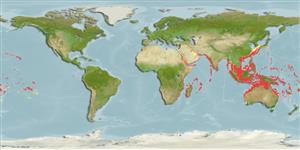
Southeast Atlantic: East London, South Africa (Ref. 5484). Indo-Pacific: Red Sea and East Africa to the Marquesas and Line islands, north to southern Japan, south to Australia.
Lengte bij maturiteit / Grootte / Gewicht / Leeftijd
Maturiteit: Lm 20.5, range 17 - 25 cm
Max length : 40.0 cm TL mannelijk / geslacht onbekend; (Ref. 4883); common length : 25.0 cm TL mannelijk / geslacht onbekend; (Ref. 55); max. gerapporteerde leeftijd: 6 Jaren (Ref. 82366)
Dorsale stekels (totaal) : 10; Dorsale zachte stralen (totaal) : 14 - 15; Anale stekels: 3; Anale zachte stralen: 7 - 8.
Body shape (shape guide): fusiform / normal; Cross section: oval.
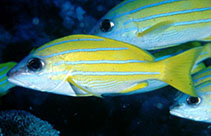
Adults inhabit coral reefs, occurring in both shallow lagoons and on outer reef slopes. Frequently found in large aggregations around coral formation, caves or wrecks during the day. Juveniles inhabit seagrass beds around patch reefs (Ref. 9710). Benthopelagic (Ref. 58302). Food consists of fishes, shrimps, crabs, stomatopods, cephalopods, and planktonic crustaceans. Also take a variety of algae (Ref. 4821). Minimum depth reported taken from Ref. 30874.
Allen, G.R., 1985. FAO Species Catalogue. Vol. 6. Snappers of the world. An annotated and illustrated catalogue of lutjanid species known to date. FAO Fish. Synop. 125(6):208 p. Rome: FAO. (Ref. 55)
Status op de Rode Lijst van het IUCN (Ref. 130435: Version 2025-2 (Global))
Gevaar voor de mens
Harmless
Gebruik door de mens
Visserij: commercieel; sportvis: ja; Aquarium: Commercieel
Tools
Speciale rapporten
Download XML
Internetbronnen
Schattingen op basis van modellen
Gewenste temperatuur (Ref.
123201): 19.1 - 28.3, mean 26.4 °C (based on 1181 cells).
Fylogenetische diversiteitsindex (Ref.
82804): PD
50 = 0.5000 [Uniqueness, from 0.5 = low to 2.0 = high].
Bayesian length-weight: a=0.01514 (0.01351 - 0.01695), b=2.97 (2.95 - 2.99), in cm total length, based on LWR estimates for this species (Ref.
93245).
Trofisch niveau (Ref.
69278): 3.9 ±0.3 se; based on diet studies.
Weerstandsvermogen (Ref.
120179): Gemiddeld, minimale populatieverdubbelingstijd 1,4-4,4 jaar (K=0.21-0.38; tmax=6;).
Prior r = 0.56, 95% CL = 0.37 - 0.85, Based on 1 data-limited stock assessment.
Kwetsbaarheid van de visserij (Ref.
59153): Moderate vulnerability (40 of 100).
🛈
Kwetsbaarheid voor het klimaat (Ref.
125649): Moderate to high vulnerability (50 of 100).
🛈
Voedingsstoffen (Ref.
124155): Calcium = 32.2 [20.6, 44.6] mg/100g; Iron = 0.315 [0.209, 0.480] mg/100g; Protein = 18.3 [16.8, 19.6] %; Omega3 = 0.154 [0.114, 0.203] g/100g; Selenium = 74.6 [51.2, 104.5] μg/100g; VitaminA = 174 [34, 624] μg/100g; Zinc = 0.462 [0.381, 0.625] mg/100g (wet weight); based on
nutrient studies.