>
Clupeiformes (Herrings) >
Dorosomatidae (Gizzard shads and sardinellas)
Etymology: Sardinella: Latin and Greek, sarda = sardine; name related to the island of Sardinia; diminutive (Ref. 45335).
More on author: Day.
Entorno: milieu / zona climática / rango de profundidad / gama de distribución
Ecología
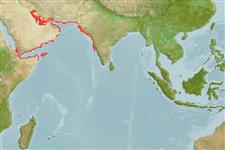
marino pelagic-neritic; rango de profundidad 0 - 50 m (Ref. 188). Tropical; 30°N - 10°N, 42°E - 74°E (Ref. 188)
Western Indian Ocean: Arabian Sea, from Gulf of Aden to the Persian Gulf and Bombay.
Tamaño / Peso / Edad
Madurez: Lm ? range ? - ? cm
Max length : 17.0 cm SL macho / no sexado; (Ref. 188); common length : 14.0 cm SL macho / no sexado; (Ref. 188)
Descripción breve
Claves de identificación | Morfología | Morfometría
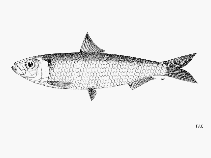
Espinas dorsales (total) : 0; Radios blandos dorsales (total) : 13 - 21; Espinas anales: 0; Radios blandos anales: 12 - 23. Total number of scutes 31 to 34; lower gill rakers increasing with size of fish. Vertical striae on scales not meeting at center, only a few small perforations on hind part of scale. Closely resembles S. gibbosa which has fewer perforations on its scales. Of other sympatric Sardinella species, S. melanura has distinctive black caudal tips while S. albella has fewer scutes.
Body shape (shape guide): fusiform / normal; Cross section: compressed.
Coastal pelagic (Ref. 68964). Forms schools in coastal waters. Marketed fresh and dried-salted.
Ciclo vital y comportamiento de apareamiento
Madurez | Reproducción | Puesta | Huevos | Fecundidad | Larva
Whitehead, P.J.P., 1985. FAO Species Catalogue. Vol. 7. Clupeoid fishes of the world (suborder Clupeoidei). An annotated and illustrated catalogue of the herrings, sardines, pilchards, sprats, shads, anchovies and wolf-herrings. FAO Fish. Synop. 125(7/1):1-303. Rome: FAO. (Ref. 188)
Situación en la Lista Roja de la UICN (Ref. 130435: Version 2025-2 (Global))
Amenaza para el ser humano
Harmless
Usos humanos
Pesquerías: escaso valor comercial
Herramientas
Informes especiales
Descargar XML
Fuentes de Internet
Estimaciones basadas en modelos
Temperatura preferida (Referencia
123201): 24.9 - 29.2, mean 26.9 °C (based on 172 cells).
Índice de diversidad filogenética (Referencia
82804): PD
50 = 0.5000 [Uniqueness, from 0.5 = low to 2.0 = high].
Bayesian length-weight: a=0.00813 (0.00490 - 0.01347), b=3.01 (2.87 - 3.15), in cm total length, based on LWR estimates for this species & Genus-body shape (Ref.
93245).
Resiliencia (Referencia
120179): Alto, población duplicada en un tiempo mínimo inferior a 15 meses (Preliminary K or Fecundity.).
Vulnerabilidad pesquera (Ref.
59153): Low vulnerability (13 of 100).
🛈
Nutrientes (Ref.
124155): Calcium = 321 [173, 498] mg/100g; Iron = 2.22 [1.31, 3.98] mg/100g; Protein = 20.6 [19.6, 21.5] %; Omega3 = 0.301 [0.148, 0.587] g/100g; Selenium = 98.3 [51.3, 191.7] μg/100g; VitaminA = 25.4 [8.5, 74.7] μg/100g; Zinc = 1.32 [0.96, 1.81] mg/100g (wet weight);