>
Clupeiformes (Herrings) >
Dorosomatidae (Gizzard shads and sardinellas)
Etymology: Sardinella: Latin and Greek, sarda = sardine; name related to the island of Sardinia; diminutive (Ref. 45335).
More on author: Valenciennes.
Ambiente: milieu / zona climática / intervalo de profundidade / gama de distribuição
Ecologia
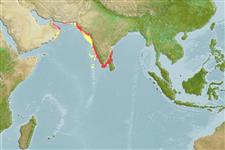
marinhas pelagic-neritic; oceanódromo (Ref. 51243); intervalo de profundidade 20 - 200 m (Ref. 28016). Tropical; 25°N - 7°N, 57°E - 81°E (Ref. 54872)
Indian Ocean: northern and western parts only, Gulf of Aden, Gulf of Oman, but apparently not Red Sea or the Persian Gulf, eastward to southern part of India, on eastern coast to Andhra; possibly to the Andaman Islands. Thus, studies pertaining to this species from the Philippines or Indonesia probably refer to Sardinella lemuru.
Comprimento na primeira maturidade / Tamanho / Peso / Idade
Maturidade: Lm 16.3 range ? - ? cm
Max length : 23.0 cm SL macho/indeterminado; (Ref. 188); common length : 20.0 cm SL macho/indeterminado; (Ref. 188); peso máx. Publicado: 200.00 g (Ref. 4883); Idade máx. registada: 3 anos (Ref. 3689)
Descrição breve
Chaves de identificação | Morfologia | Morfometria
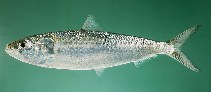
Espinhos dorsais (total) : 0; Raios dorsais moles (total) : 13 - 21; Espinhos anais: 0; Raios anais moles: 12 - 23; Vértebras: 45 - 49. Body sub-cylindrical; a faint golden spot behind gill opening, followed by a faint golden mid-lateral line; a distinct black spot at hind border of gill cover (absence of pigment). Distinguished from all clupeids in the northern Indian Ocean by its pelvic fin ray count of i 8; from S. neglecta and S. lemuru by its longer head and more lower gill rakers. No prominent keel. See also Refs. 3683, 818 and 393 .
Body shape (shape guide): fusiform / normal; Cross section: compressed.
Coastal pelagic (Ref. 68964). Forms schools in coastal waters and strongly migratory. Feeds mainly on phytoplankton (especially diatoms) and small crustaceans (Ref. 30573). Breeds once a year off western coasts of India when temperatures and salinity are low during the southwest monsoon months. Spawning peaks in August-September. Occurs at temperatures of 22.0-28.0 °C (Ref. 3689). Marketed fresh, dried and dried-salted. Also sold smoked and canned (Ref. 9987). Also made into fish meal and fish balls.
Spawning usually takes place at night (Ref. 810).
Whitehead, P.J.P., 1985. FAO Species Catalogue. Vol. 7. Clupeoid fishes of the world (suborder Clupeoidei). An annotated and illustrated catalogue of the herrings, sardines, pilchards, sprats, shads, anchovies and wolf-herrings. FAO Fish. Synop. 125(7/1):1-303. Rome: FAO. (Ref. 188)
Categoria na Lista Vermelha da IUCN (Ref. 130435: Version 2025-2 (Global))
Ameaça para o homem
Harmless
Utilização humana
Pescarias: altamente comercial
Ferramentas
Relatórios especiais
Descarregue XML
Fontes da internet
Estimativas baseadas em modelos
Temperatura preferida (Ref.
123201): 22.1 - 26.7, mean 24.7 °C (based on 63 cells).
Índice de diversidade filogenética (Ref.
82804): PD
50 = 0.5000 [Uniqueness, from 0.5 = low to 2.0 = high].
Bayesian length-weight: a=0.00692 (0.00592 - 0.00808), b=3.03 (3.00 - 3.06), in cm total length, based on LWR estimates for this species (Ref.
93245).
Nível Trófico (Ref.
69278): 2.4 ±0.22 se; based on food items.
Generation time: 1.2 (1.1 - 2.0) years. Estimated as median ln(3)/K based on 19
growth studies.
Resiliência (Ref.
120179): Médio, tempo mínimo de duplicação da população 1,4 - 4,4 anos (K=0.5-1.4; tm=2; tmax=3; Fec=19,028).
Prior r = 0.46, 95% CL = 0.31 - 0.69, Based on 1 full stock assessment.
Vulnerabilidade da pesca (Ref.
59153): Low vulnerability (17 of 100).
🛈
Vulnerabilidade climática (Ref.
125649): Moderate to high vulnerability (53 of 100).
🛈
Nutrientes (Ref.
124155): Calcium = 243 [124, 369] mg/100g; Iron = 1.94 [1.13, 3.42] mg/100g; Protein = 20.2 [19.2, 21.2] %; Omega3 = 0.302 [0.145, 0.589] g/100g; Selenium = 130 [68, 257] μg/100g; VitaminA = 22.9 [6.9, 69.7] μg/100g; Zinc = 1.3 [0.9, 1.8] mg/100g (wet weight); based on
nutrient studies.