>
Clupeiformes (Herrings) >
Dorosomatidae (Gizzard shads and sardinellas)
Etymology: Sardinella: Latin and Greek, sarda = sardine; name related to the island of Sardinia; diminutive (Ref. 45335).
More on author: Bleeker.
البيئة: الوسط / المنطقة المناخية / نطاق العمق / نطاق التوزيع
البيئة
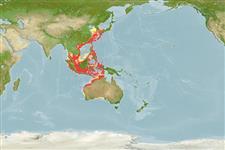
بحري pelagic-neritic; محيطية (Ref. 51243); نطاق العمق 15 - 100 m (Ref. 12260). Tropical; 38°N - 33°S, 97°E - 134°E (Ref. 54869)
Eastern Indian Ocean: Phuket, Thailand; southern coasts of East Java and Bali; and Western Australia. Western Pacific: Java Sea, Philippines, Hong Kong, Taiwan Island, southern Japan. Can not be distinguished as yet on morphological grounds from Sardinella aurita which occurs in the Atlantic Ocean.
الطول عند النضج الأول / الحجم / وزن / العمر
النضج: Lm 14.3, range 14 - 15 cm
Max length : 23.0 cm SL ذكر/ مختلط الجنس; (Ref. 188); common length : 20.0 cm SL ذكر/ مختلط الجنس; (Ref. 188)
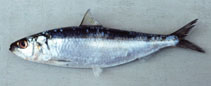
الأشواك الظهرية (المجموع) : 0; الأشعة الظهرية الناعمة (المجموع) : 13 - 21; شوكة شرجية: 0; أشعه شرجية لينه: 12 - 23. A faint golden spot behind gill opening, followed by a faint golden mid-lateral line; a distinct black spot at hind border of gill cover (absence of pigment). Body elongate, sub-cylindrical. Distinguished from all other clupeids in the eastern Indian Ocean and western Pacific by its pelvic fin ray count of i 8; from S. longiceps by its shorter head length and fewer lower gill rakers.
Body shape (shape guide): fusiform / normal; Cross section: compressed.
Adults form large schools in coastal waters, particularly in the Bali Strait upwelling. Found in sheltered bays and lagoons (Ref. 48635). They feed on phytoplankton and zooplankton, chiefly copepods. Time series analysis (Ref. 9586) suggests that recruitment fluctuations are related to ENSO events, as defined in Ref. 9577, 9578 and 9580.
Spawning tends to take place in inshore waters where salinity is low (Ref. 6863) at the beginning of the rainy season. Spawning aggregations may be formed, also including Amblygaster sirm, A. leogaster and Clupea fimbriata.
Whitehead, P.J.P., 1985. FAO Species Catalogue. Vol. 7. Clupeoid fishes of the world (suborder Clupeoidei). An annotated and illustrated catalogue of the herrings, sardines, pilchards, sprats, shads, anchovies and wolf-herrings. FAO Fish. Synop. 125(7/1):1-303. Rome: FAO. (Ref. 188)
حالة القائمة الحمراء للاتحاد الدولي لحفظ الطبيعة والموارد الطبيعية (Ref. 130435: Version 2025-2 (Global))
استخدامات بشرية
مصائد: ذو قيمة تاجرية عالية
أدوات
تقارير خاصة
تنزيل XML
مصادر علي الأنترنت
تقديرات تستند إلى النماذج
درجة الحرارة المفضلة (مرجع
123201): 22.8 - 28.6, mean 27.8 °C (based on 500 cells).
مؤشر التنوع الشُعبي الوراثي (مرجع
82804): PD
50 = 0.5000 [Uniqueness, from 0.5 = low to 2.0 = high].
Bayesian length-weight: a=0.00724 (0.00467 - 0.01123), b=3.10 (2.97 - 3.23), in cm total length, based on LWR estimates for this species & Genus-body shape (Ref.
93245).
مستوى غذائي (مرجع
69278): 2.5 ±0.00 se; based on food items.
Generation time: 1.1 (1.0 - 1.3) years. Estimated as median ln(3)/K based on 18
growth studies.
المرونه (مرجع
120179): عالي, الحد الزمني الأدني لتضاعف عدد أفراد المجتمع أقل من 15 شهر (K=0.8-1.3; tmax=4.5).
Prior r = 1.19, 95% CL = 0.79 - 1.79, Based on 6 data-limited stock assessments.
ضعف الصيد (Ref.
59153): Low vulnerability (17 of 100).
🛈
قابلية التأثر بالمناخ (Ref.
125649): Moderate to high vulnerability (46 of 100).
🛈
المغذيات (Ref.
124155): Calcium = 257 [134, 389] mg/100g; Iron = 1.99 [1.18, 3.52] mg/100g; Protein = 20.3 [19.3, 21.3] %; Omega3 = 0.286 [0.140, 0.547] g/100g; Selenium = 114 [61, 228] μg/100g; VitaminA = 22.2 [7.0, 65.8] μg/100g; Zinc = 1.3 [0.9, 1.8] mg/100g (wet weight);