Entorno: milieu / zona climática / rango de profundidad / gama de distribución
Ecología
marino asociado a arrecife; oceanodromo (Ref. 51243); rango de profundidad 1 - 100 m (Ref. 89707). Tropical; 36°N - 8°N, 98°W - 58°W (Ref. 5222)
Western Atlantic: North Carolina, USA to Paraíba, Brazil (Ref. 57756). The most common species of Epinephelus in the West Indies.
Longitud en la primera madurez / Tamaño / Peso / Edad
Madurez: Lm 25.0 range ? - ? cm
Max length : 76.0 cm TL macho / no sexado; (Ref. 5222); common length : 40.0 cm TL macho / no sexado; (Ref. 5217); peso máximo publicado: 25.0 kg (Ref. 5217); edad máxima reportada: 22 años (Ref. 31471)
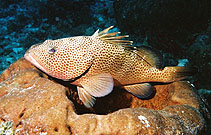
Espinas dorsales (total) : 11; Radios blandos dorsales (total) : 15 - 16; Espinas anales: 3; Radios blandos anales: 8. Scales cycloid except for a ctenoid patch of variable size in the pectoral region. Greenish gray to light brown on the back grading to white ventrally, with numerous well-spaced dull orange-red to brown spots on the head, body and fins. Five faint diagonal bars formed by darker spots on the sides. No saddle-shaped blotch on caudal peduncle or along base of dorsal fin (Ref. 26938); further characterized by having body depth contained 2.7-3.1 times in standard length; head length 2.3-2.4 times in standard length; evenly serrate preopercle, without salient angle; posterior nostril larger than anterior nostril (Ref. 89707).
Body shape (shape guide): fusiform / normal; Cross section: oval.
Found in shallow reefs and rocky bottoms, occurring down to depths of at least 100 meters (Ref. 89707). Usually solitary and territorial. Feed mainly on crabs (Calapa and Mithrax) and other crustaceans (alpheid shrimps and scyllarid lobsters), fishes (labrids and haemulids), and octopus. Some undergo sexual inversion at 28 cm TL; most fish larger than 40 cm are males. Important in terms of numbers caught and total weight of landings in the Caribbean.
Easily approached by divers (Ref. 9710). Hermaphrodite species. Excellent food fish (Ref. 26938). Readily caught on hook and line and easily speared (Ref. 13442).
Females rest on or close to the bottom, while males patrol around an area that consists of 1 to 5 females and defend this territory from other males. Form aggregation and reproduce almost exclusively within the aggregation period (Ref. 8557).
Heemstra, P.C. and J.E. Randall, 1993. FAO Species Catalogue. Vol. 16. Groupers of the world (family Serranidae, subfamily Epinephelinae). An annotated and illustrated catalogue of the grouper, rockcod, hind, coral grouper and lyretail species known to date. Rome: FAO. FAO Fish. Synop. 125(16):382 p. (Ref. 5222)
Situación en la Lista Roja de la UICN (Ref. 130435: Version 2025-2 (Global))
Amenaza para el ser humano
Reports of ciguatera poisoning (Ref. 31172)
Usos humanos
Pesquerías: muy comercial; pesca deportiva: si
Herramientas
Informes especiales
Descargar XML
Fuentes de Internet
Estimaciones basadas en modelos
Índice de diversidad filogenética (Referencia
82804): PD
50 = 0.5000 [Uniqueness, from 0.5 = low to 2.0 = high].
Bayesian length-weight: a=0.01148 (0.01017 - 0.01296), b=3.04 (3.02 - 3.06), in cm total length, based on LWR estimates for this species (Ref.
93245).
Nivel trófico (Referencia
69278): 3.8 ±0.3 se; based on diet studies.
Resiliencia (Referencia
120179): Medio, población duplicada en un tiempo mínimo de 1.4-4.4 años (K=0.12-0.24; tm=3; tmax=17; Fec=96,000).
Prior r = 0.43, 95% CL = 0.28 - 0.64, Based on 2 data-limited stock assessments.
Vulnerabilidad pesquera (Ref.
59153): Moderate to high vulnerability (52 of 100).
🛈
Vulnerabilidad climática (Ref.
125649): Very high vulnerability (88 of 100).
🛈
Nutrientes (Ref.
124155): Calcium = 21 [10, 46] mg/100g; Iron = 0.452 [0.243, 0.903] mg/100g; Protein = 18.5 [17.0, 19.9] %; Omega3 = 0.126 [0.078, 0.201] g/100g; Selenium = 47.2 [27.8, 83.6] μg/100g; VitaminA = 141 [40, 485] μg/100g; Zinc = 1.15 [0.81, 1.60] mg/100g (wet weight);