>
Clupeiformes (Herrings) >
Dorosomatidae (Gizzard shads and sardinellas)
Etymology: Harengula: Old English haring, hering = mackerel, the fish Clupea harengus (Ref. 45335).
More on author: Poey.
Ambiente: milieu / zona climática / intervalo de profundidade / gama de distribuição
Ecologia
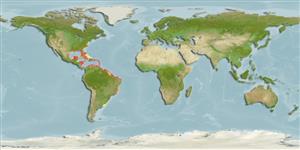
marinhas; estuarina associadas(os) a recifes; intervalo de profundidade ? - 22 m (Ref. 26912), usually 1 - 5 m (Ref. 40849). Tropical; 43°N - 37°S, 99°W - 33°W (Ref. 188)
Western Atlantic: New Jersey, USA and Bermuda southward to Florida (USA), Gulf of Mexico, Caribbean, and southern Brazil. Often confused with Harengula clupeola with which it co-occurs over most of its range.
Comprimento na primeira maturidade / Tamanho / Peso / Idade
Maturidade: Lm 8.1, range 8 - 8.5 cm
Max length : 21.2 cm TL macho/indeterminado; (Ref. 5217); common length : 12.0 cm SL macho/indeterminado; (Ref. 188); Idade máx. registada: 3.00 anos (Ref. 12193)
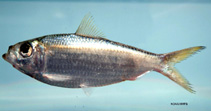
Espinhos dorsais (total) : 0; Raios dorsais moles (total) : 13 - 21; Espinhos anais: 0; Raios anais moles: 12 - 23. Tooth plate on tongue and tooth plate behind it (basihyal and basibranchial tooth plates) very broad, their width about 3 to 5 times in their combined length, the basihyal tooth plate with a very distinct bulge in front (Ref. 188). Scales fairly strongly attached, not easily lost (Ref. 188). No dark pigment on dorsal fin tip (Ref. 188). No orange or red spot at opercle. Belly deep, lower profile decidedly more curved than the flattened upper profile (Ref. 7251).
Body shape (shape guide): fusiform / normal; Cross section: compressed.
Occurs in coastal waters, over mud sand bottoms and frequently near brackish or hyper-saline estuaries (Ref. 5217). Forms schools. Marketed fresh or canned.
Juveniles of 2.9 to 4.4 cm SL appeared in Guanabara Bay, Rio de Janeiro, in May and migrated out in December or March at 7.5 to 8.0 cm.
Whitehead, P.J.P., 1985. FAO Species Catalogue. Vol. 7. Clupeoid fishes of the world (suborder Clupeoidei). An annotated and illustrated catalogue of the herrings, sardines, pilchards, sprats, shads, anchovies and wolf-herrings. FAO Fish. Synop. 125(7/1):1-303. Rome: FAO. (Ref. 188)
Categoria na Lista Vermelha da IUCN (Ref. 130435: Version 2025-2 (Global))
Ameaça para o homem
Harmless
Utilização humana
Pescarias: pouco comercial
Ferramentas
Relatórios especiais
Descarregue XML
Fontes da internet
Estimativas baseadas em modelos
Temperatura preferida (Ref.
123201): 23.2 - 28.1, mean 27.1 °C (based on 872 cells).
Índice de diversidade filogenética (Ref.
82804): PD
50 = 0.5625 [Uniqueness, from 0.5 = low to 2.0 = high].
Bayesian length-weight: a=0.00871 (0.00759 - 0.01000), b=3.07 (3.03 - 3.11), in cm total length, based on LWR estimates for this species (Ref.
93245).
Nível Trófico (Ref.
69278): 3.4 ±0.0 se; based on diet studies.
Resiliência (Ref.
120179): Médio, tempo mínimo de duplicação da população 1,4 - 4,4 anos (K=0.48-0.60; tmax=3; Fec=5,000).
Vulnerabilidade da pesca (Ref.
59153): Low vulnerability (21 of 100).
🛈
Nutrientes (Ref.
124155): Calcium = 86.2 [44.5, 151.8] mg/100g; Iron = 0.898 [0.473, 1.548] mg/100g; Protein = 19.5 [18.2, 20.7] %; Omega3 = 0.231 [0.131, 0.402] g/100g; Selenium = 25.5 [13.4, 49.8] μg/100g; VitaminA = 123 [40, 348] μg/100g; Zinc = 1.56 [1.06, 2.25] mg/100g (wet weight);