>
Clupeiformes (Herrings) >
Clupeidae (Herrings, shads, sardines, menhadens)
Etymology: Sprattus: Old German, sprotte (1611) = a small fish, Clupea sp. (Ref. 45335).
Eponymy: Baron Dr Sir Ferdinand Jacob Heinrich von Müller (1825–1896) was a German-born Australian botanist, geographer, explorer, physician, and naturalist. [...] (Ref. 128868), visit book page.
More on author: Klunzinger.
Milieu: milieu / Klimaatzone / Diepte / verspreidingsgebied
Ecologie
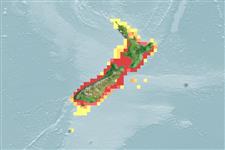
marien pelagic-neritic; diepte 28 - 110 m (Ref. 58489). Subtropical; 33°S - 51°S, 165°E - 180°E (Ref. 188)
Southwest Pacific: New Zealand.
Grootte / Gewicht / Leeftijd
Maturiteit: Lm ? range ? - ? cm
Max length : 13.0 cm SL mannelijk / geslacht onbekend; (Ref. 188); common length : 10.0 cm SL mannelijk / geslacht onbekend; (Ref. 188)
Korte beschrijving
Determinatiesleutels | Morfologie | Morfometrie
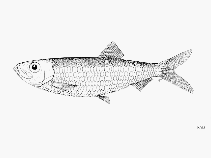
Dorsale stekels (totaal) : 0; Dorsale zachte stralen (totaal) : 13 - 21; Anale stekels: 0; Anale zachte stralen: 12 - 23; Wervels: 43 - 47. Gill cover without bony radiating striae; tooth plate on tongue narrow, pointed at each end, its width about 4 or 5 times in length, lateral teeth moderate; scales without fine striae on exposed posterior part; back green-gray when fresh. Pterotic bulla absent. Last two anal rays normal.
Body shape (shape guide): fusiform / normal; Cross section: compressed.
A schooling species found in coastal waters, from beaches down to 110 m or more. Has an apparently long spawning season (July to January) around the South Island, but not a fractional spawner. Eggs are present in mid-summer near Clutha River mouth (but samples may have included S. antipodum). More data needed.
Levenscyclus en paargedrag
Maturiteit | Voortplanting | Paaien | Eieren | Fecunditeit | Larven
Eggs present in mid-summer near Clutha River mouth (but samples may also have included S. antipodum).
Whitehead, P.J.P., 1985. FAO Species Catalogue. Vol. 7. Clupeoid fishes of the world (suborder Clupeoidei). An annotated and illustrated catalogue of the herrings, sardines, pilchards, sprats, shads, anchovies and wolf-herrings. FAO Fish. Synop. 125(7/1):1-303. Rome: FAO. (Ref. 188)
Status op de Rode Lijst van het IUCN (Ref. 130435: Version 2025-2 (Global))
Gevaar voor de mens
Harmless
Gebruik door de mens
Visserij: visserij voor eigen gebruik
Tools
Speciale rapporten
Download XML
Internetbronnen
Schattingen op basis van modellen
Gewenste temperatuur (Ref.
123201): 10 - 16.6, mean 14.3 °C (based on 29 cells).
Fylogenetische diversiteitsindex (Ref.
82804): PD
50 = 0.5313 [Uniqueness, from 0.5 = low to 2.0 = high].
Bayesian length-weight: a=0.00676 (0.00331 - 0.01379), b=3.13 (2.95 - 3.31), in cm total length, based on LWR estimates for this (Sub)family-body shape (Ref.
93245).
Trofisch niveau (Ref.
69278): 2.8 ±0.2 se; based on size and trophs of closest relatives
Weerstandsvermogen (Ref.
120179): Hoog, minimale populatieverdubbelingstijd minder dan 15 maanden (Preliminary K or Fecundity.).
Kwetsbaarheid van de visserij (Ref.
59153): Low vulnerability (10 of 100).
🛈