>
Cichliformes (Cichlids, convict blennies) >
Cichlidae (Cichlids) > Pseudocrenilabrinae
Etymology: Sarotherodon: Greek, saros, -ou = sawdust + Greek, ther = animal * Greek, odous = teeth (Ref. 45335).
Eponymy: Gunnar Linnell was a Swedish plantation owner in Cameroon, who was Lönnberg’s friend. He sent a collection of fishes and crustaceans from that country, including the type of this cichlid. (Ref. 128868), visit book page.
More on author: Lönnberg.
Environnement : milieu / zone climatique / profondeur / gamme de distribution
Écologie
; eau douce démersal. Tropical; 24°C - 26°C (Ref. 13614); 5°N - 4°N
Africa: endemic to Lake Barombi Mbo, West Cameroon (Ref. 4999, 52307, 81260).
Taille / Poids / Âge
Maturité: Lm ? range ? - ? cm
Max length : 18.5 cm SL mâle / non sexé; (Ref. 81260)
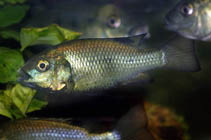
Épines dorsales (Total) : 14 - 16; Rayons mous dorsaux (Total) : 10 - 12; Épines anales: 3; Rayons mous anaux: 8 - 11; Vertèbres: 29. Diagnosis: 15-20 rakers on lower limb of first arch; 30-32 scales in lateral line (Ref. 81260). Body dark grey or green (Ref. 2, 81260). Head large, especially in adults (Ref. 2), its length 37-45% of standard length (Ref. 81260). Jaw teeth very small (Ref. 81260). Breeding males green; intense tilapia-mark present in young until about 10 cm SL, absent above 15 cm SL; as the gonads mature the lower parts of the head and the flanks become more metallic and green; most brooding females silver grey in general color; fins mainly of a neutral color; pelvic fins may be yellow (Ref. 2).
Body shape (shape guide): short and / or deep.
Occasionally forms schools; is mainly diurnal; juveniles feed on mayfly larvae and various terrestrial insects among a diet in which animal items formed a high proportion (Ref. 2). Adults feed predominantly on phytoplankton (Ref. 2, 52307). Congregates in small groups (under 10 individuals) in open water regions and at a maximum depth of about 5 m (Ref. 52307). Lacks marked sexual dichromatism when sexually active (Ref. 81260). Ovophilic, maternal mouth brooder (Ref. 52307) that forms temporary pair bonds (Ref. 81260) prior to spawning, but none after (Ref. 52307). Ventures to regions near the edges of the lake for spawning, where the male constructs craters in the sand; males infrequently incubate the eggs (Ref. 52307).
Cycle de vie et comportement reproducteur
Maturité | Reproduction | Frai | Œufs | Fécondité | Larves
Brooding by both sexes, predominantly by the female.
Trewavas, E. and G.G. Teugels, 1991. Sarotherodon. p. 425-437. In J. Daget, J.-P. Gosse, G.G. Teugels and D.F.E. Thys van den Audenaerde (eds.) Check-list of the freshwater fishes of Africa (CLOFFA). ISNB, Brussels; MRAC, Tervuren; and ORSTOM, Paris. Vol. 4. (Ref. 4999)
Statut dans la liste rouge de l'IUCN (Ref. 130435: Version 2025-2 (Global))
Menace pour l'homme
Harmless
Utilisations par l'homme
Aquaculture: probable utilisation future
Outils
Articles particuliers
Télécharger en XML
Sources Internet
Estimations basées sur des modèles
Indice de diversité phylogénétique (Réf.
82804): PD
50 = 0.5001 [Uniqueness, from 0.5 = low to 2.0 = high].
Bayesian length-weight: a=0.01905 (0.00846 - 0.04293), b=3.01 (2.82 - 3.20), in cm total length, based on LWR estimates for this (Sub)family-body shape (Ref.
93245).
Niveau trophique (Réf.
69278): 2.6 ±0.26 se; based on food items.
Résilience (Réf.
120179): Haut, temps minimum de doublement de population inférieur à 15 mois (Preliminary K or Fecundity.).
Vulnérabilité de la pêche (Ref.
59153): Low vulnerability (13 of 100).
🛈