>
Cichliformes (Cichlids, convict blennies) >
Cichlidae (Cichlids) > Pseudocrenilabrinae
Etymology: Sarotherodon: Greek, saros, -ou = sawdust + Greek, ther = animal * Greek, odous = teeth (Ref. 45335).
Eponymy: Gunnar Linnell was a Swedish plantation owner in Cameroon, who was Lönnberg’s friend. He sent a collection of fishes and crustaceans from that country, including the type of this cichlid. (Ref. 128868), visit book page.
More on author: Lönnberg.
Lingkungan: lingkungan / zona iklim / kisaran kedalaman / jangkauan distribusi
Ekologi
; air tawar dasar (demersal). Tropical; 24°C - 26°C (Ref. 13614); 5°N - 4°N
Africa: endemic to Lake Barombi Mbo, West Cameroon (Ref. 4999, 52307, 81260).
Ukuran / Berat / umur
Kematangan: Lm ? range ? - ? cm
Max length : 18.5 cm SL jantan/; (Ref. 81260)
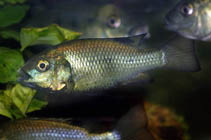
Duri punggung (Keseluruhan (total)) : 14 - 16; duri punggung lunak (Keseluruhan (total)) : 10 - 12; Duri dubur: 3; Sirip dubur lunak: 8 - 11; vertebrata, bertulang belakang: 29. Diagnosis: 15-20 rakers on lower limb of first arch; 30-32 scales in lateral line (Ref. 81260). Body dark grey or green (Ref. 2, 81260). Head large, especially in adults (Ref. 2), its length 37-45% of standard length (Ref. 81260). Jaw teeth very small (Ref. 81260). Breeding males green; intense tilapia-mark present in young until about 10 cm SL, absent above 15 cm SL; as the gonads mature the lower parts of the head and the flanks become more metallic and green; most brooding females silver grey in general color; fins mainly of a neutral color; pelvic fins may be yellow (Ref. 2).
Body shape (shape guide): short and / or deep.
Occasionally forms schools; is mainly diurnal; juveniles feed on mayfly larvae and various terrestrial insects among a diet in which animal items formed a high proportion (Ref. 2). Adults feed predominantly on phytoplankton (Ref. 2, 52307). Congregates in small groups (under 10 individuals) in open water regions and at a maximum depth of about 5 m (Ref. 52307). Lacks marked sexual dichromatism when sexually active (Ref. 81260). Ovophilic, maternal mouth brooder (Ref. 52307) that forms temporary pair bonds (Ref. 81260) prior to spawning, but none after (Ref. 52307). Ventures to regions near the edges of the lake for spawning, where the male constructs craters in the sand; males infrequently incubate the eggs (Ref. 52307).
Brooding by both sexes, predominantly by the female.
Trewavas, E. and G.G. Teugels, 1991. Sarotherodon. p. 425-437. In J. Daget, J.-P. Gosse, G.G. Teugels and D.F.E. Thys van den Audenaerde (eds.) Check-list of the freshwater fishes of Africa (CLOFFA). ISNB, Brussels; MRAC, Tervuren; and ORSTOM, Paris. Vol. 4. (Ref. 4999)
Status IUCN Red List (Ref. 130435: Version 2025-2 (Global))
ancaman kepada manusia
Harmless
penggunaan manusia
Budidaya air: kemungkinan penggunaan kedepan
Alat, peralatan
laporan khas
muat turun XML
Sumber internet
Estimasi berdasarkan model
Indeks keanekaragaman filogenetik (Acuan
82804): PD
50 = 0.5001 [Uniqueness, from 0.5 = low to 2.0 = high].
Bayesian length-weight: a=0.01905 (0.00846 - 0.04293), b=3.01 (2.82 - 3.20), in cm total length, based on LWR estimates for this (Sub)family-body shape (Ref.
93245).
Tingkat Trofik (Acuan
69278): 2.6 ±0.26 se; based on food items.
Daya lenting (Acuan
120179): Tinggi, Waktu penggandaan populasi minimum kurang dari 15 bulan (Preliminary K or Fecundity.).
Kerentanan Penangkapan Ikan (Ref.
59153): Low vulnerability (13 of 100).
🛈