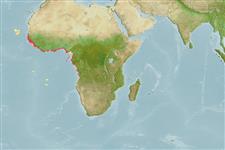
Miljö: miljö / Klimatzon / djupintervall / distributionsområde
Ekologi
marina; sötvatten; brackvatten revassocierade; djupintervall 0 - 50 m (Ref. 55). Tropical; 34°N - 17°S, 27°W - 14°E (Ref. 55)
Eastern Atlantic: west coast of Africa (Ref. 57393) from Senegal to Congo (Ref. 81653), primarily in the Gulf of Guinea and Cape Verde Islands (Ref. 57393, 81653).
Storlek / Vikt / Ålder
Könsmognad: Lm ? range ? - ? cm
Max length : 80.0 cm TL hane/ej könsbestämd; (Ref. 55); common length : 50.0 cm TL hane/ej könsbestämd; (Ref. 55)
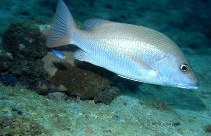
Taggstrålar i ryggfenan (totalt) : 10; Mjukstrålar i ryggfenan (totalt) : 14; Taggstrålar i analfenan: 3; Mjukstrålar i analfenan: 8. Diagnosis: body stocky (Ref. 57393), relatively deep (Ref. 81653). Head pointed, dorsal profile of forehead abrupt/steep (Ref. 55, 57393, 81653). Eyes large (Ref. 81653). Preorbital/lachrymal bone (very) broad (Ref. 55, 81653). Maxilla extending to about mid-eye level (Ref. 55, 57393, 81653). Vomerine tooth plate triangular with a pronounced, long, postero-median extension (Ref. 57393, 81653). Pectoral fins of adult not reaching level of anus (Ref. 55, 81653). Scales medium-sized and ctenoid (Ref. 57393, 81653). Scale rows on back parallel to lateral line (Ref. 55, 57393, 81653), 5-7 rows below spinous part of dorsal fin (Ref. 57393, 81653). 5-6 transverse scale rows on cheek (Ref. 55, 57393, 81653). Presence of narrow blue band from snout to angle of opercle (Ref. 55, 57393, 81653) or a row of broken spots below eye (ref. 55). Small specimens from shallow water mainly brownish (Ref. 55).
Coloration: back vermilion red, becoming bright pink in large individuals and fading progressively to whitish on belly; blue subocular line, either continuous or fragmented, running from upper jaw to angle of opercle; juveniles more or less uniformly brownish (Ref. 57393).
Body shape (shape guide): fusiform / normal; Cross section: oval.
Adults occur on rocky bottoms and in the vicinity of coral reefs (Ref. 55, 57393, 81653). Young are frequently encountered in coastal waters, particularly estuaries and sometimes in lower courses of rivers (Ref. 2683, 57393, 81653). Voracious predator (Ref. 57393), feeds mainly on fishes and bottom-dwelling invertebrates (Ref. 55). Size of juveniles ranges from 7.90 to 19.99 cm in length (Ref. 111357).
Livscykel och parningsbeteende
Könsmognad | Reproduktion | Lek | Ägg | Fekunditet | Larver
Allen, G.R., 1985. FAO Species Catalogue. Vol. 6. Snappers of the world. An annotated and illustrated catalogue of lutjanid species known to date. FAO Fish. Synop. 125(6):208 p. Rome: FAO. (Ref. 55)
Status på IUCN:s rödlista (Ref. 130435: Version 2025-2 (Global))
Hot mot människor
Harmless
Mänskliga användningsområden
Fiskeri: mindre kommeriell
Verktyg
Särskilda rapporter
Ladda ner XML
Internet-källor
Uppskattningar baserade på modeller
Önskad temperatur (Ref.
123201): 23.7 - 28, mean 26.6 °C (based on 66 cells).
Index för fylogenetisk mångfald (Ref.
82804): PD
50 = 0.5000 [Uniqueness, from 0.5 = low to 2.0 = high].
Bayesian length-weight: a=0.01479 (0.01324 - 0.01652), b=2.96 (2.94 - 2.98), in cm total length, based on LWR estimates for this species (Ref.
93245).
Trofisk nivå (Ref.
69278): 4.0 ±0.59 se; based on food items.
Resiliens (Ref.
120179): Låg, lägsta populationsfördubblingstid 4,5-14 år (Preliminary K or Fecundity.).
Sårbarhet i fisket (Ref.
59153): Moderate to high vulnerability (52 of 100).
🛈
Näringsämnen (Ref.
124155): Calcium = 24.3 [15.6, 34.7] mg/100g; Iron = 0.283 [0.182, 0.433] mg/100g; Protein = 18.9 [17.4, 20.2] %; Omega3 = 0.13 [0.09, 0.18] g/100g; Selenium = 60.8 [39.8, 89.5] μg/100g; VitaminA = 111 [20, 386] μg/100g; Zinc = 0.455 [0.363, 0.613] mg/100g (wet weight);