>
Cichliformes (Cichlids, convict blennies) >
Cichlidae (Cichlids) > Pseudocrenilabrinae
Etymology: Oreochromis: Latin, aurum = gold + Greek, chromis = a fish, perhaps a perch (Ref. 45335).
More on author: Boulenger.
محیط زیست: محیط زیست / منطقه آب و هوایی / تغييرات عمق / محدوده توزیع
بوم شناسي
; آب شيرين موجوداتی که در محدوده وسیعی از آبهای آزاد از نزدیک بستر و یا روی کف بستر، در قسمت های میان آبی تا سطح آب و در برخی گونه ها با قابلیت پرواز، زندگی و تغذیه می کنند.; تغييرات عمق 4 - 49 m. Tropical; 23°C - 28°C (Ref. 3)
Africa: Lake Victoria and its affluent rivers (Ref. 5166, 34290, 118630, 118638), Victoria Nile above Murchison Falls (Ref. 5166) and Lakes Kyoga, Kwania and Salisbury (Ref. 5166), but strongly declining or disappeared in many areas (Ref. 52331), apparently replaced by Oreochromis niloticus (Ref. 34290). Introduced into several dams in Lake Victoria region (Ref. 118638).
اندازه / وزن / سن
بلوغ: Lm ? range ? - ? cm
Max length : 30.0 cm SL جنس نر / بدون خواص جنسي; (Ref. 34290)
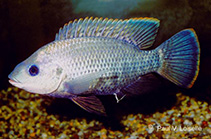
خارهاي باله پشتي (کل) : 16 - 18; شعاع نرم باله پشتي (کل) : 10 - 12; خارهاي باله مخرجي: 3; شعاع نرم باله مخرجي: 9 - 11; مهره ها: 29 - 31. Diagnosis: Large bodied tilapiine cichlid; females and unripe males have a grey/green body and fins with 6-7 dark vertical bars on the flank; ripening males with yellowish chin, and notable bright red/orange margins to the dorsal and caudal fins; fully ripe males are black with a blue sheen on the head, bright red/orange margins to the dorsal and caudal fins and a long, branched whitish or yellow genital tassel (Ref. 118638). The breeding male of Oreochromis variabilis is distinguished from O. niloticus and O. esculentus by the intense orange to scarlet colour of the margin of the dorsal fin and the long, tasselled genital papilla, as well as by the general body colour; the orange dorsal margin is present also in grown females and non-breeding males, though narrower and less brilliant (Ref. 2). Other distinguishing characters are: the tilapia-mark is absent in young longer than 15 mm standard length, whereas in O. esculentus it is conspicuous and with a clear ring up to about 70 mm standard length and may still be detected up to 170 mm; the profile usually has a convexity immediately before the eye; there are usually two rows of scales on the cheek in contrast to usually three in O. esculentus; in half-grown and full-grown fishes there are 4-7 series of teeth in the jaws, 3-5 in O. esculentus; the ratio depth of preorbital to length of head is more than 1/5 in O. variabilis, 1/5 or less in O. esculentus; longer gill-rakers; and whereas O. esculentus does not mount beyond the estuaries, O. variabilis enters rivers from the lake (Ref. 2). Oreochromis variabilis differs from both O. malagarasi and O. upembae, its nearest relatives, in the suppression in most phases of blotches on the flanks, in the body colour of mature males, which is blue-grey to blue-black vs. yellowish in O. upembae, in the shape of the profile, which in O. malagarasi and O. upembae lacks the 'bump' before the eye, a lower modal number of soft dorsal and anal rays, and a higher modal number of vertebrae; Oreochromis upembae also differs from O. variabilis in having usually narrow vertical stripes on the caudal fin (Ref. 2).
Body shape (shape guide): fusiform / normal; Cross section: compressed.
Adults feed predominantly on bottom algae, some of the planktonic organisms that are found in their stomachs are probably those which have settled on the bottom or were washed shorewards from open waters but they do feed directly on plankton (Ref. 2). A maternal mouthbrooder, males make complex courtship structures in the substrate (Ref. 118638). Was a major component of the fisheries catch in Lake Victoria (Ref. 118638). Some pond culture attempted (Ref. 118638). IUCN conservation status is critically endangered (Ref. 118638).
Nests are built on sandy bottoms in shallow waters. Each nest consists of a central shallow saucer 13-15 cm in diameter, around which is a circle of small pits. This structure is the center of a larger pit, 30-39 cm in diameter. Breeding pair makes the T-stand. Female lays batches of eggs; picks them up and sucks at the male's genital tassel.
Trewavas, E., 1983. Tilapiine fishes of the genera Sarotherodon, Oreochromis and Danakilia. British Mus. Nat. Hist., London, UK. 583 p. (Ref. 2)
وضعيت در فهرست قرمز IUCN (Ref. 130435: Version 2025-2 (Global))
خطر برای انسان ها
Harmless
استفاده انسانی
ماهي گيري – شيلات: تجاري; آبزي پروري: آزمايشي; آكواريوم: تجاري
ابزارها
گزارش های ويژه
بارگيری XML
منابع اينترنتي
تخمینها بر اساس مدلها
شاخص تنوع فیلوژنتیکی (مرجع
82804): PD
50 = 0.5000 [Uniqueness, from 0.5 = low to 2.0 = high].
Bayesian length-weight: a=0.01479 (0.00656 - 0.03333), b=2.99 (2.82 - 3.16), in cm total length, based on LWR estimates for this Genus-body shape (Ref.
93245).
سطح تروفیک (مرجع
69278): 2.0 ±0.00 se; based on food items.
Generation time: 3.1 ( na - na) years. Estimated as median ln(3)/K based on 2
growth studies.
جهندگی (مرجع
120179): متوسط, كمينه زمان لازم براي دو برابر شدن جمعيت 4/1 – 4/4 سال (Fec=500).
آسیبپذیری ماهیگیری (Ref.
59153): Low vulnerability (18 of 100).
🛈