>
Eupercaria/misc (Various families in series Eupercaria) >
Lutjanidae (Snappers) > Lutjaninae
Etymology: Lutjanus: Malay, ikan lutjan, name of a fish.
More on author: Poey.
Milieu: milieu / Klimaatzone / Diepte / verspreidingsgebied
Ecologie
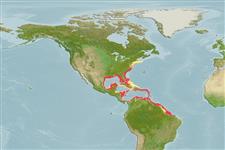
marien rifbewoner; diepte 10 - 190 m (Ref. 55), usually 30 - 130 m (Ref. 55). Subtropical; 43°N - 4°S, 100°W - 40°W (Ref. 55228)
Western Atlantic: Gulf of Mexico and eastern coast of the USA extending northward to Massachusetts, coasts of Florida (Ref. 26938), but rare north of the Carolinas. Throughout Gulf of Mexico (Ref. 26938). This species has been referred to as Lutjanus aya by previous authors, but Rivas (Ref. 6409) proved that Bodianus aya Bloch, 1790 is not a lutjanid, but probably a sciaenid.
Lengte bij maturiteit / Grootte / Gewicht / Leeftijd
Maturiteit: Lm 39.3, range 25 - 47.5 cm
Max length : 100.0 cm TL mannelijk / geslacht onbekend; (Ref. 26938); common length : 60.0 cm TL mannelijk / geslacht onbekend; (Ref. 55); max. gepubliceerd gewicht: 22.8 kg (Ref. 40637); max. gerapporteerde leeftijd: 57 Jaren (Ref. 48779)
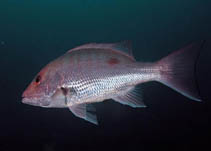
Dorsale stekels (totaal) : 10; Dorsale zachte stralen (totaal) : 14; Anale stekels: 3; Anale zachte stralen: 8 - 9. Scale rows on back rising obliquely above lateral line. Specimens under 30 to 35 cm with large dark spot on the upper sides, located below the anterior soft dorsal rays.
Body shape (shape guide): fusiform / normal; Cross section: oval.
Adults are found over rocky bottoms. Juveniles inhabit shallow waters, common over sand or muddy bottoms. Feed mainly on fishes, shrimps, crabs, worms, cephalopods, and some planktonic items including urochordates and gastropods. Marketed fresh and eaten steamed, broiled and baked (Ref. 9988). Heavily exploited in American waters where it is now closely protected; shrimp fishing, accused of destroying young snappers, is currently restricted.
Allen, G.R., 1985. FAO Species Catalogue. Vol. 6. Snappers of the world. An annotated and illustrated catalogue of lutjanid species known to date. FAO Fish. Synop. 125(6):208 p. Rome: FAO. (Ref. 55)
Status op de Rode Lijst van het IUCN (Ref. 130435: Version 2025-2 (Global))
Gevaar voor de mens
Reports of ciguatera poisoning (Ref. 30303)
Gebruik door de mens
Visserij: commercieel; sportvis: ja
Tools
Speciale rapporten
Download XML
Internetbronnen
Schattingen op basis van modellen
Gewenste temperatuur (Ref.
123201): 19.7 - 27.5, mean 24.4 °C (based on 218 cells).
Fylogenetische diversiteitsindex (Ref.
82804): PD
50 = 0.5000 [Uniqueness, from 0.5 = low to 2.0 = high].
Bayesian length-weight: a=0.01479 (0.01320 - 0.01657), b=2.96 (2.94 - 2.98), in cm total length, based on LWR estimates for this species (Ref.
93245).
Trofisch niveau (Ref.
69278): 3.9 ±0.72 se; based on food items.
Generation time: 6.9 (6.1 - 7.8) years. Estimated as median ln(3)/K based on 19
growth studies.
Weerstandsvermogen (Ref.
120179): Zeer laag, minimale populatieverdubbelingstijd meer dan 14 jaar (K=0.05-0.35; tmax=57; tm=2-4.5; Fec > 1 million).
Prior r = 0.48, 95% CL = 0.31 - 0.71, Based on 2 data-limited stock assessments.
Kwetsbaarheid van de visserij (Ref.
59153): Moderate to high vulnerability (54 of 100).
🛈
Kwetsbaarheid voor het klimaat (Ref.
125649): Moderate to high vulnerability (51 of 100).
🛈
Voedingsstoffen (Ref.
124155): Calcium = 13.4 [7.2, 20.3] mg/100g; Iron = 0.274 [0.163, 0.455] mg/100g; Protein = 19.2 [17.8, 20.6] %; Omega3 = 0.195 [0.122, 0.314] g/100g; Selenium = 42 [23, 74] μg/100g; VitaminA = 59 [11, 265] μg/100g; Zinc = 0.245 [0.180, 0.365] mg/100g (wet weight);