>
Eupercaria/misc (Various families in series Eupercaria) >
Lutjanidae (Snappers) > Lutjaninae
Etymology: Lutjanus: Malay, ikan lutjan, name of a fish.
Ambiente: milieu / zona climática / intervalo de profundidade / gama de distribuição
Ecologia
marinhas; Água doce; estuarina associadas(os) a recifes; intervalo de profundidade 0 - 180 m (Ref. 37816), usually 10 - 70 m (Ref. 30573). Tropical; 31°N - 33°S, 31°E - 128°W (Ref. 55)
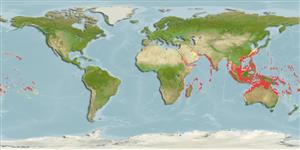
Indo-Pacific: East Africa to the Marquesas and Line islands, north to the Ryukyu Islands, south to Australia. More common around oceanic islands than in continental areas.
Comprimento na primeira maturidade / Tamanho / Peso / Idade
Maturidade: Lm 42.9, range 39 - ? cm
Max length : 90.0 cm TL macho/indeterminado; (Ref. 9987); common length : 76.0 cm SL macho/indeterminado; (Ref. 37816); peso máx. Publicado: 12.5 kg (Ref. 4699); Idade máx. registada: 55 anos (Ref. 72420)
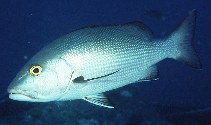
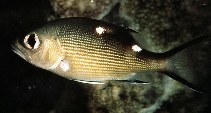
Espinhos dorsais (total) : 10; Raios dorsais moles (total) : 13 - 14; Espinhos anais: 3; Raios anais moles: 8. This species is distinguished by the following characters: moderately deep body, its greatest depth 2.4-2.9 in SL; distinct groove or pit from nostrils to the front of the eye; preopercular notch and knob moderately developed; vomerine tooth patch narrow crescentic, without a medial posterior extension; gill rakers of first gill arch 6-7 + 16 = 22-23 (including rudiments). Colour of body dark reddish-brown with faint dark stripes; young and some adults with two silvery-white spots on back; pectoral fins pink with dorsal edge prominently black; juveniles sometimes have caudal end of body and the tail white. mimicking Chromis damselfishes (Ref. 9821, 90102).
Body shape (shape guide): fusiform / normal; Cross section: oval.
Adults inhabit coral reefs, including sheltered lagoons and outer reefs (Ref. 30573). Usually found singly, often adjacent to steep outer reef slopes, but occasionally found in groups (Ref. 9710). Feeds mainly on fishes, but also take shrimps, crabs, amphipods, stomatopods, gastropods and urochordates. Large fish from oceanic areas in the western Pacific are often ciguatoxic, e.g., in Tuvalu (Ref. 9513). Caught mainly with handlines and bottom longlines (Ref. 9821). Utilized fresh and dried-salted (Ref. 9987). Juveniles mimic Chromis damselfishes (Ref. 90102). Minimum depth reported taken from Ref. 128797.
Allen, G.R., 1985. FAO Species Catalogue. Vol. 6. Snappers of the world. An annotated and illustrated catalogue of lutjanid species known to date. FAO Fish. Synop. 125(6):208 p. Rome: FAO. (Ref. 55)
Categoria na Lista Vermelha da IUCN (Ref. 130435: Version 2025-2 (Global))
Ameaça para o homem
Reports of ciguatera poisoning (Ref. 4690)
Utilização humana
Pescarias: espécies comerciais; peixe desportivo: sim
Ferramentas
Relatórios especiais
Descarregue XML
Fontes da internet
Estimativas baseadas em modelos
Temperatura preferida (Ref.
123201): 24.5 - 29, mean 28 °C (based on 2402 cells).
Índice de diversidade filogenética (Ref.
82804): PD
50 = 0.5000 [Uniqueness, from 0.5 = low to 2.0 = high].
Bayesian length-weight: a=0.01479 (0.01321 - 0.01656), b=2.96 (2.94 - 2.98), in cm total length, based on LWR estimates for this species (Ref.
93245).
Nível Trófico (Ref.
69278): 4.3 ±0.5 se; based on diet studies.
Resiliência (Ref.
120179): Muito baixo, tempo mínimo de duplicação da população maior que 14 anos (K=0.05-3; tmax=55; tm=9).
Prior r = 0.41, 95% CL = 0.27 - 0.61, Based on 1 data-limited stock assessment.
Vulnerabilidade da pesca (Ref.
59153): High to very high vulnerability (68 of 100).
🛈
Vulnerabilidade climática (Ref.
125649): Very high vulnerability (85 of 100).
🛈
Nutrientes (Ref.
124155): Calcium = 18.4 [11.0, 26.7] mg/100g; Iron = 0.245 [0.156, 0.388] mg/100g; Protein = 18.8 [17.2, 20.1] %; Omega3 = 0.142 [0.101, 0.196] g/100g; Selenium = 77.5 [48.8, 127.5] μg/100g; VitaminA = 130 [22, 516] μg/100g; Zinc = 0.44 [0.35, 0.59] mg/100g (wet weight); based on
nutrient studies.