Environnement : milieu / zone climatique / profondeur / gamme de distribution
Écologie
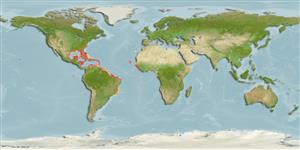
marin démersal; profondeur 1 - 120 m (Ref. 36484), usually ? - 15 m (Ref. 3589). Tropical; 40°N - 24°S, 99°W - 9°E (Ref. 5222)
Western Atlantic: Massachusetts, USA and Bermuda to the Gulf of Mexico, the Caribbean and southern Brazil. Eastern Atlantic: Ascension and St. Helena islands; dubious records from the Canary Islands, Cape Verde and South Africa (Ref. 1496, 1953, 6572) are discussed by Heemstra (Ref. 6512). Also recorded from eastern Atlantic from Sao Tome in the Gulf of Guinea and from the Azores (Portugal) (Ref. 089707).
Longueur à la première maturité / Taille / Poids / Âge
Maturité: Lm 30.4, range 25 - 36 cm
Max length : 65.0 cm TL mâle / non sexé; (Ref. 118680); common length : 35.0 cm TL mâle / non sexé; (Ref. 5217); poids max. publié: 4.5 kg (Ref. 118249); âge max. reporté: 25 années (Ref. 118249)
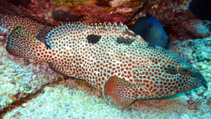
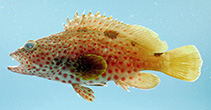
Épines dorsales (Total) : 11; Rayons mous dorsaux (Total) : 16 - 17; Épines anales: 3; Rayons mous anaux: 8. Maxilla without scales. Preopercle with rounded, only slightly enlarged, spines at its angle. Opercle with 3 flat spines, middle one the largest. Pelvic fins shorter than pectorals and shorter than longest dorsal spine. Bases of soft dorsal and anal fins covered with scales and thick skin. 2 or 3 dark saddles along base of dorsal fin and another on top of caudal peduncle. Tan with red spots on head, body and fins, spots becoming larger ventrally (Ref. 26938); characterized further by: body depth less than head length, 2.6-3.2 times in SL; head length 2.1-2.5 in SL; interorbital area flat or slightly concave; preopercle evenly serrate; smooth subopercle and interopercle; subequal posterior and anterior nostrils (Ref. 089707).
Body shape (shape guide): fusiform / normal.
Inhabits rocky reefs. Usually solitary (Ref. 29). Difficult to approach (Ref. 9710). Juveniles often seen in rockpools (Ref. 86997). Feeds mainly on crabs (67%) and fishes (20%). In the Ascension I., feeds on juvenile Melichthys niger and young sea turtles. Its flesh is of good quality. Marketed fresh. Angling: Like other grouper, rock hind are caught by fishing at the right depth over an irregular bottom (Ref. 84357).
Cycle de vie et comportement reproducteur
Maturité | Reproduction | Frai | Œufs | Fécondité | Larves
Heemstra, P.C. and J.E. Randall, 1993. FAO Species Catalogue. Vol. 16. Groupers of the world (family Serranidae, subfamily Epinephelinae). An annotated and illustrated catalogue of the grouper, rockcod, hind, coral grouper and lyretail species known to date. Rome: FAO. FAO Fish. Synop. 125(16):382 p. (Ref. 5222)
Statut dans la liste rouge de l'IUCN (Ref. 130435: Version 2025-2 (Global))
Menace pour l'homme
Reports of ciguatera poisoning (Ref. 31172)
Utilisations par l'homme
Pêcheries: hautement commercial; pêche sportive: oui
Outils
Articles particuliers
Télécharger en XML
Sources Internet
Estimations basées sur des modèles
Température préférée (Réf.
123201): 24.2 - 28.1, mean 27.3 °C (based on 1043 cells).
Indice de diversité phylogénétique (Réf.
82804): PD
50 = 0.5000 [Uniqueness, from 0.5 = low to 2.0 = high].
Bayesian length-weight: a=0.01175 (0.00735 - 0.01879), b=3.10 (2.97 - 3.23), in cm total length, based on LWR estimates for this species & Genus-body shape (Ref.
93245).
Niveau trophique (Réf.
69278): 3.5 ±0.4 se; based on diet studies.
Résilience (Réf.
120179): Faible, temps minimum de doublement de population : 4,5 à 14 années (K=0.11).
Vulnérabilité de la pêche (Ref.
59153): High vulnerability (63 of 100).
🛈
Nutriments (Ref.
124155): Calcium = 86.2 [37.2, 188.8] mg/100g; Iron = 0.991 [0.462, 2.360] mg/100g; Protein = 17.7 [16.1, 19.2] %; Omega3 = 0.203 [0.104, 0.371] g/100g; Selenium = 71.6 [34.9, 165.7] μg/100g; VitaminA = 32.5 [8.0, 126.3] μg/100g; Zinc = 1.24 [0.78, 2.01] mg/100g (wet weight);