>
Gadiformes (Cods) >
Gadidae (Cods and haddocks)
Etymology: Melanogrammus: Greek, melan, -anos = black + Greek, gramma = letter, signal (Ref. 45335).
More on author: Linnaeus.
Milieu: milieu / Klimaatzone / Diepte / verspreidingsgebied
Ecologie
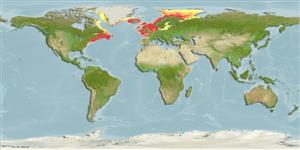
marien demersaal; oceanodroom (Ref. 51243); diepte 10 - 450 m, usually 10 - 200 m (Ref. 35388). Temperate; 79°N - 36°N, 76°W - 62°E
North Atlantic and adjacent Arctic. Mediterranean Sea to southern Greenland, Iceland, and southern Barents Sea.
Lengte bij maturiteit / Grootte / Gewicht / Leeftijd
Maturiteit: Lm 34.9 range ? - ? cm
Max length : 112 cm TL mannelijk / geslacht onbekend; (Ref. 5951); common length : 35.0 cm TL mannelijk / geslacht onbekend; (Ref. 4645); max. gepubliceerd gewicht: 16.8 kg (Ref. 9988); max. gerapporteerde leeftijd: 20 Jaren (Ref. 4645)
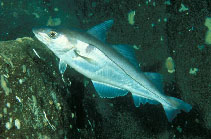
Dorsale stekels (totaal) : 0; Anale stekels: 0. Mouth relatively small; lower jaw shorter than the upper jaw; chin barbel rather small. Lateral line dark, uninterrupted to about the end of the body. Lateral-line pores present on head. Scales overlapping. A large dark blotch is above the pectoral fin just below the lateral line.
Body shape (shape guide): fusiform / normal; Cross section: circular.
Adults are found more commonly from 80 to 200 m, over rock, sand, gravel or shells, usually at temperatures between 4° and 10°C. Feed mainly on small bottom-living organisms including crustaceans, mollusks, echinoderms, worms and fishes (sand lance, capelin, silver hake, American eels, herring and argentines) (Ref. 5951). A batch spawner (Ref. 51846). Undertakes extensive migrations in the Barents Sea and Iceland. Sold fresh, chilled as fillets, frozen, smoked and canned. Also utilized for fish meal and animal feeds. Can be steamed, fried, broiled, boiled, microwaved and baked (Ref. 9988).
Oviparous, sexes are separate (Ref. 205). Spawning occurs in typically marine waters between 50 and 150 m depth (Ref. 1371).
Cohen, D.M., T. Inada, T. Iwamoto and N. Scialabba, 1990. FAO species catalogue. Vol. 10. Gadiform fishes of the world (Order Gadiformes). An annotated and illustrated catalogue of cods, hakes, grenadiers and other gadiform fishes known to date. FAO Fish. Synop. 125(10). Rome: FAO. 442 p. (Ref. 1371)
Status op de Rode Lijst van het IUCN (Ref. 130435: Version 2025-2 (Global))
Gevaar voor de mens
Harmless
Gebruik door de mens
Visserij: van groot commercieel belang; Aquacultuur: experimenteel; sportvis: ja
Tools
Speciale rapporten
Download XML
Internetbronnen
Schattingen op basis van modellen
Gewenste temperatuur (Ref.
123201): 1.4 - 12.1, mean 8.4 °C (based on 1651 cells).
Fylogenetische diversiteitsindex (Ref.
82804): PD
50 = 1.0000 [Uniqueness, from 0.5 = low to 2.0 = high].
Bayesian length-weight: a=0.00661 (0.00583 - 0.00748), b=3.08 (3.04 - 3.12), in cm total length, based on LWR estimates for this species (Ref.
93245).
Trofisch niveau (Ref.
69278): 4.0 ±0.1 se; based on diet studies.
Generation time: 5.0 (4.6 - 5.6) years. Estimated as median ln(3)/K based on 36
growth studies.
Weerstandsvermogen (Ref.
120179): Gemiddeld, minimale populatieverdubbelingstijd 1,4-4,4 jaar (rm=0.54-1.2; K=0.12-0.30; tm=2-6.5; tmax=20; Fec=100,000).
Prior r = 0.50, 95% CL = 0.33 - 0.75, Based on 41 full stock assessments.
Kwetsbaarheid van de visserij (Ref.
59153): Moderate to high vulnerability (55 of 100).
🛈
Kwetsbaarheid voor het klimaat (Ref.
125649): Moderate vulnerability (40 of 100).
🛈
Voedingsstoffen (Ref.
124155): Calcium = 10.2 [3.2, 40.2] mg/100g; Iron = 0.175 [0.075, 0.825] mg/100g; Protein = 18 [16, 20] %; Omega3 = 0.617 [0.316, 1.243] g/100g; Selenium = 32.9 [12.1, 89.8] μg/100g; VitaminA = 7.92 [2.06, 29.85] μg/100g; Zinc = 0.309 [0.168, 0.623] mg/100g (wet weight); based on
nutrient studies.