>
Lophiiformes (Anglerfishes) >
Lophiidae (Goosefishes)
Etymology: Lophiodes: Greek, lophos = crest + Greek, suffix oides = similar to (Ref. 45335).
More on author: Garman.
Entorno: milieu / zona climática / rango de profundidad / gama de distribución
Ecología
marino demersal; rango de profundidad 15 - 311 m (Ref. 9538). Deep-water; 37°N -
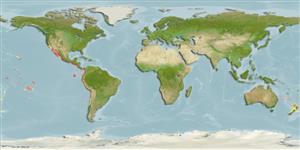
Eastern Pacific: Baja California, Mexico to Peru. Range extends northward to the vicinity of Morro Bay, California (Ref. 36490).
Tamaño / Peso / Edad
Madurez: Lm ? range ? - ? cm
Max length : 40.0 cm TL macho / no sexado; (Ref. 9538); common length : 30.0 cm TL macho / no sexado; (Ref. 9538)
Descripción breve
Claves de identificación | Morfología | Morfometría
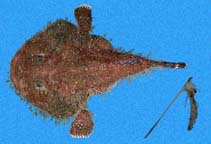
Espinas dorsales (total) : 3 - 4; Radios blandos dorsales (total) : 8; Espinas anales: 0; Radios blandos anales: 6 - 7; Vértebra: 19. Head and anterior part of the body depressed; posterior part of body gradually narrowing; back and sides of head with numerous spines; first dorsal fin formed by 3 isolated cephalic spines, the first of which resembles a fishing rod (bearing a scale that looks like "bait" and two prominent, dark "eyes") and three more short, thin, post-cephalic spines connected by a low membrane. Back brown or dark brown; belly lighter; fins darker distally but may have light edges; caudal fin with a vertical row of 6 pale spots (Ref. 55763). Head is flattened and mouth is large. The first two dorsal fin spines are displaced far forward (onto the snout), and the first is modified into a lure to attract prey. Branchiostegal rays: 6 (Ref. 36490).
Body shape (shape guide): short and / or deep.
Juveniles and adults are benthic on the continental shelf and the upper regions of the continental slope (Ref. 9538). Oviparous, with planktonic larvae (Ref. 36490). Eggs are contained in floating gelatinous rafts (Ref. 36490). Probably caught as a by-catch of trawl fishing (Ref. 9538).
Ciclo vital y comportamiento de apareamiento
Madurez | Reproducción | Puesta | Huevos | Fecundidad | Larva
Oviparous (Ref. 36490). Eggs are contained in floating gelatinous rafts (Ref. 36490).
Caruso, J.H., 1995. Lophiidae. Rapes. p. 1227-1230. In W. Fischer, F. Krupp, W. Schneider, C. Sommer, K.E. Carpenter and V. Niem (eds.) Guia FAO para Identification de Especies para lo Fines de la Pesca. Pacifico Centro-Oriental. 3 Vols. FAO, Rome. (Ref. 9538)
Situación en la Lista Roja de la UICN (Ref. 130435: Version 2025-2 (Global))
Amenaza para el ser humano
Harmless
Usos humanos
Herramientas
Informes especiales
Descargar XML
Fuentes de Internet
Estimaciones basadas en modelos
Temperatura preferida (Referencia
123201): 12.1 - 21.2, mean 15.1 °C (based on 106 cells).
Índice de diversidad filogenética (Referencia
82804): PD
50 = 0.5000 [Uniqueness, from 0.5 = low to 2.0 = high].
Bayesian length-weight: a=0.01698 (0.01034 - 0.02790), b=3.01 (2.86 - 3.16), in cm total length, based on LWR estimates for this species & (Sub)family-body (Ref.
93245).
Nivel trófico (Referencia
69278): 4.5 ±0.80 se; based on food items.
Resiliencia (Referencia
120179): Medio, población duplicada en un tiempo mínimo de 1.4-4.4 años (Preliminary K or Fecundity.).
Vulnerabilidad pesquera (Ref.
59153): Low to moderate vulnerability (30 of 100).
🛈