>
Carangiformes (Jacks) >
Carangidae (Jacks and pompanos) > Caranginae
Etymology: Trachurus: Greek, trachys, -eia, -ys = rough + Greek, oura = tail (Ref. 45335).
More on author: Linnaeus.
Environnement : milieu / zone climatique / profondeur / gamme de distribution
Écologie
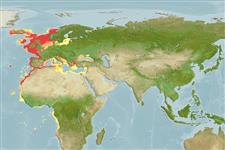
marin pelagic-neritic; océanodrome (Ref. 51243); profondeur 0 - 1050 m (Ref. 54256), usually 100 - 200 m (Ref. 54256). Subtropical; 67°N - 38°S, 26°W - 42°E
Eastern Atlantic: Norway to Cape of Good Hope, South Africa to southwestern Indian Ocean (South Africa to southern Mozambique), and Baltic Sea, North Sea, Mediterranean Sea and Black Sea.
Longueur à la première maturité / Taille / Poids / Âge
Maturité: Lm 22.9, range 21 - 30 cm
Max length : 70.0 cm TL mâle / non sexé; (Ref. 3197); common length : 22.0 cm FL mâle / non sexé; (Ref. 3397); poids max. publié: 2.0 kg (Ref. 27584)
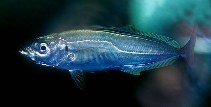
Épines dorsales (Total) : 9; Rayons mous dorsaux (Total) : 30 - 36; Épines anales: 3; Rayons mous anaux: 24 - 32. Bluish green, grey or black above, silvery white below; opercle with black spot (Ref. 3197). Lateral scales tall and keeled. Gill cover with a distinct black spot. First dorsal fin tall (Ref. 35388).
Body shape (shape guide): fusiform / normal.
Adults form large schools in coastal areas with sandy substrate. They feed on fish, crustaceans, and cephalopods. Are batch spawners (Ref. 51846). Females lay 140,000 eggs, which hatch into 5mm long larvae (Ref. 35388). Eggs are pelagic (Ref. 4233). Utilized fresh, smoked, canned and frozen; can be fried, broiled and baked (Ref. 9988). Divided into two stocks: West stock and North Sea stock. West stock spawns in a belt from the Biscay to Ireland in early spring, migrates north and eastwards to southern Norway and northern North Sea. North Sea stock spawns in the southern North Sea in summer, migrates to central North Sea, Skagerrak and Kattegat.
Smith-Vaniz, W.F., 1986. Carangidae. p. 815-844. In P.J.P. Whitehead, M.-L. Bauchot, J.-C. Hureau, J. Nielsen and E. Tortonese (eds.) Fishes of the north-eastern Atlantic and the Mediterranean. UNESCO, Paris. vol. 2. (Ref. 4233)
Statut dans la liste rouge de l'IUCN (Ref. 130435: Version 2025-2 (Global))
Menace pour l'homme
Harmless
Utilisations par l'homme
Pêcheries: hautement commercial; pêche sportive: oui; appât: usually
Outils
Articles particuliers
Télécharger en XML
Sources Internet
Estimations basées sur des modèles
Température préférée (Réf.
123201): 10.6 - 16.6, mean 13.3 °C (based on 165 cells).
Indice de diversité phylogénétique (Réf.
82804): PD
50 = 0.5001 [Uniqueness, from 0.5 = low to 2.0 = high].
Bayesian length-weight: a=0.00813 (0.00745 - 0.00886), b=2.97 (2.95 - 2.99), in cm total length, based on LWR estimates for this species (Ref.
93245).
Niveau trophique (Réf.
69278): 3.7 ±0.0 se; based on diet studies.
Generation time: 6.5 (5.1 - 7.6) years. Estimated as median ln(3)/K based on 25
growth studies.
Résilience (Réf.
120179): Milieu, temps minimum de doublement de population : 1,4 à 4,4 années (K=0.18; tm=2-4; tmax=11).
Prior r = 0.39, 95% CL = 0.26 - 0.58, Based on 13 full stock assessments.
Vulnérabilité de la pêche (Ref.
59153): High vulnerability (56 of 100).
🛈
Vulnérabilité climatique (Ref.
125649): Low vulnerability (25 of 100).
🛈
Nutriments (Ref.
124155): Calcium = 184 [129, 263] mg/100g; Iron = 3.67 [2.45, 5.60] mg/100g; Protein = 19.4 [18.8, 20.0] %; Omega3 = 0.355 [0.260, 0.479] g/100g; Selenium = 33.4 [24.6, 45.6] μg/100g; VitaminA = 13.5 [4.0, 54.4] μg/100g; Zinc = 1.66 [1.34, 2.16] mg/100g (wet weight); based on
nutrient studies.