Taxonomic Remarks
Family placement uncertain.
Umwelt: Milieu / Klimazone / Tiefenbereich / Verbreitungsgebiet
Ökologie
seewasser; brackwasser benthopelagisch. Temperate
Northwest Pacific: southern Sea of Japan and East China Sea.
Größe / Gewicht / Alter
Geschlechtsreife: Lm ? range ? - ? cm
Max length : 40.0 cm SL Männchen/unbestimmt; (Ref. 559)
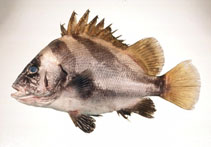
Rückenflossenstacheln (insgesamt) : 11; Rückenflossenweichstrahlen (insgesamt) : 14 - 16; Afterflossenstacheln: 3; Afterflossenweichstrahlen: 9 - 10. Diagnosis: Distinguished from its congeners with the following characters: dorsal-fin rays XI, 14-16 (usually 15); scales above lateral line 10-15 (usually 12-14), below 20-27 (usually 22-25); maxilla scaly; 10 pores on and behind chin, including 1 very small pore near symphysis on each side (may be difficult to detect, obscured by short dense papillae), 2 moderate-sized pores anteroventrally on each dentary, a single large pore ventrally, at articulation of dentary (2 posteriormost usually slit-like and concave), its posterior part scaly; shape of dorsal- and anal-fin rays rounded and slightly angulated, respectively; cluster of very short dense papillae on fleshy lower lip; body often with two indistinct oblique dark bands, the first descending from nape to behind pectoral fin and then running to posterior part of soft anal-fin rays, and the second from base of anterior 3rd or 4th dorsal-fin spine and soft dorsal-fin base, curving backwards through lateral line to upper part of caudal peduncle (Ref. 56360).
Body shape (shape guide): short and / or deep; Cross section: compressed.
Inhabits rocky reefs in coastal waters (Ref. 9137) and river mouths; usually over sandy bottoms near rocky shores, from summer to early winter (Ref. 56360).
Lebenszyklus und Paarungsverhalten
Geschlechtsreife | Fortpflanzung | Ablaichen | Eier | Fruchtbarkeit | Larven
Iwatsuki, Y. and T. Nakabo, 2005. Redescription of Hapologenys nigripinnis (Schlegel in Temminck and Schlegel, 1843), a senior synonym of H. nitens Richardson, 1844, and a new species from Japan. Copeia 2005(4):854-867. (Ref. 56360)
IUCN Rote Liste Status (Ref. 130435: Version 2025-2 (Global))
Bedrohung für Menschen
Harmless
Nutzung durch Menschen
Fischereien: kommerziell
Tools
Zusatzinformationen
Download XML
Internet Quellen
Schätzungen auf der Grundlage von Modellen
Phylogenetischer Diversitätsindex (Ref.
82804): PD
50 = 0.5039 [Uniqueness, from 0.5 = low to 2.0 = high].
Bayesian length-weight: a=0.01445 (0.00772 - 0.02707), b=2.99 (2.82 - 3.16), in cm total length, based on LWR estimates for this species & (Sub)family-body (Ref.
93245).
Trophische Ebene (Ref.
69278): 4.0 ±0.65 se; based on food items.
Widerstandsfähigkeit (Ref.
120179): hoch, Verdopplung der Population dauert weniger als 15 Monate. (Preliminary K or Fecundity.).
Anfälligkeit der Fischerei (Ref.
59153): Moderate vulnerability (39 of 100).
🛈