Classificazione / Nomi
Nomi Comuni | Sinonimi | Catalog of Fishes(Genere, Specie) | ITIS | CoL | WoRMS | Cloffa
Elasmobranchi (squali e razze) (sharks and rays) >
Myliobatiformes (Stingrays) >
Myliobatidae (Eagle and manta rays)
Etymology: Myliobatis: Greek, mylo = mill + Greek, + Greek, batis,-idos = a ray (Raja sp.) (Ref. 45335).
Ambiente: milieu / zona climatica / distribuzione batimetrica / gamma di distribuzione
Ecologia
marino; salmastro benthopelagico; distribuzione batimetrica 0 - 160 m (Ref. 26346). Temperate
Southwest Pacific: Norfolk Island and New Zealand, including the Kermadec Islands.
Dimensione / Peso / Età
Maturità: Lm ? range ? - ? cm
Max length : 150 cm WD maschio/sesso non determinato; (Ref. 12951); common length : 100.0 cm TL maschio/sesso non determinato; (Ref. 9258)
Breve descrizione
Chiavi di identificazione | Morfologia | Morfometria
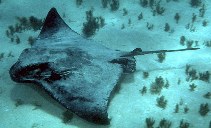
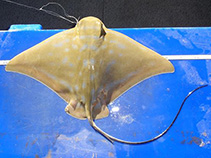
Olive-green, yellow or dark brown dorsally with pale blue or grey markings; white ventrally (Ref. 26346). No caudal fin (Ref. 26346).
Body shape (shape guide): other.
Occurs in bays, estuaries, and near rocky reefs (Ref. 12951); mostly in shallow coastal waters to depths of at least 60 m (Ref. 132213). Usually solitary (Ref. 12951). Feeds on clams, oysters, worms, and crabs (Ref. 12951). Ovoviviparous (Ref. 50449). Although the spine on the tail is capable of inflicting a painful wound, the poison is quickly neutralized by immersion of the injured area in hot water (Ref. 26346).
Ciclo vitale e comportamento di accoppiamento
Maturità | Riproduzione | Deposizione | Uova | Fecondità | Larve
Exhibit ovoviparity (aplacental viviparity), with embryos feeding initially on yolk, then receiving additional nourishment from the mother by indirect absorption of uterine fluid enriched with mucus, fat or protein through specialised structures (Ref. 50449). Young are born at less than 50 cm (Ref. 26346).
Francis, M.P., 1993. Checklist of the coastal fishes of Lord Howe, Norfolk, and Kermadec Islands, Southwest Pacific Ocean. Pac. Sci. 47(2):136-170. (Ref. 8879)
Stato della Lista Rossa IUCN (Ref. 130435: Version 2025-2 (Global))
Usi umani
Pesca: scarso interesse commerciale
Strumenti
Rapporti speciali
Scarica XML
Fonti Internet
Stime basate su modelli
Temperatura preferita (Fonte Biblio.
123201): 14.4 - 19.8, mean 16.6 °C (based on 74 cells).
Indice di diversità filogenetica (Fonte Biblio.
82804): PD
50 = 0.5002 [Uniqueness, from 0.5 = low to 2.0 = high].
Bayesian length-weight: a=0.00389 (0.00124 - 0.01219), b=3.08 (2.83 - 3.33), in cm total length, based on LWR estimates for this (Sub)family-body shape (Ref.
93245).
Livello trofico (Fonte Biblio.
69278): 3.4 ±0.4 se; based on size and trophs of closest relatives
Resilienza (Fonte Biblio.
120179): Basso, tempo minimo di raddoppiamento della popolazione 4.5 - 14 anni (Fec assumed to be <100).
Vulnerabilità della pesca (Ref.
59153): Very high vulnerability (83 of 100).
🛈
Nutrienti (Ref.
124155): Calcium = 3.64 [0.51, 61.12] mg/100g; Iron = 0.186 [0.018, 2.244] mg/100g; Protein = 19.8 [14.5, 25.0] %; Omega3 = 0.327 [0.095, 0.951] g/100g; Selenium = 14.3 [2.7, 79.6] μg/100g; VitaminA = 4.82 [0.41, 52.01] μg/100g; Zinc = 0.407 [0.030, 4.511] mg/100g (wet weight);