Klassifizierung / Names
Namen | Synonyme | Catalog of Fishes(Gattung, Arten) | ITIS | CoL | WoRMS | Cloffa
Elasmobranchii (Haie und Rochen) (sharks and rays) >
Myliobatiformes (Stingrays) >
Myliobatidae (Eagle and manta rays)
Etymology: Myliobatis: Greek, mylo = mill + Greek, + Greek, batis,-idos = a ray (Raja sp.) (Ref. 45335).
Umwelt: Milieu / Klimazone / Tiefenbereich / Verbreitungsgebiet
Ökologie
seewasser; brackwasser benthopelagisch; tiefenbereich 0 - 160 m (Ref. 26346). Temperate
Southwest Pacific: Norfolk Island and New Zealand, including the Kermadec Islands.
Größe / Gewicht / Alter
Geschlechtsreife: Lm ? range ? - ? cm
Max length : 150 cm WD Männchen/unbestimmt; (Ref. 12951); common length : 100.0 cm TL Männchen/unbestimmt; (Ref. 9258)
Kurzbeschreibung
Bestimmungsschlüssel | Morphologie | Morphometrie
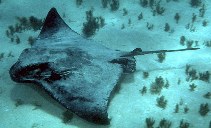
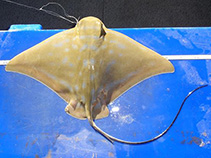
Olive-green, yellow or dark brown dorsally with pale blue or grey markings; white ventrally (Ref. 26346). No caudal fin (Ref. 26346).
Body shape (shape guide): other.
Occurs in bays, estuaries, and near rocky reefs (Ref. 12951); mostly in shallow coastal waters to depths of at least 60 m (Ref. 132213). Usually solitary (Ref. 12951). Feeds on clams, oysters, worms, and crabs (Ref. 12951). Ovoviviparous (Ref. 50449). Although the spine on the tail is capable of inflicting a painful wound, the poison is quickly neutralized by immersion of the injured area in hot water (Ref. 26346).
Lebenszyklus und Paarungsverhalten
Geschlechtsreife | Fortpflanzung | Ablaichen | Eier | Fruchtbarkeit | Larven
Exhibit ovoviparity (aplacental viviparity), with embryos feeding initially on yolk, then receiving additional nourishment from the mother by indirect absorption of uterine fluid enriched with mucus, fat or protein through specialised structures (Ref. 50449). Young are born at less than 50 cm (Ref. 26346).
Francis, M.P., 1993. Checklist of the coastal fishes of Lord Howe, Norfolk, and Kermadec Islands, Southwest Pacific Ocean. Pac. Sci. 47(2):136-170. (Ref. 8879)
IUCN Rote Liste Status (Ref. 130435: Version 2025-2 (Global))
Nutzung durch Menschen
Fischereien: weniger kommerziell
Tools
Zusatzinformationen
Download XML
Internet Quellen
Schätzungen auf der Grundlage von Modellen
Bevorzugte Temperatur (Ref.
123201): 14.4 - 19.8, mean 16.6 °C (based on 74 cells).
Phylogenetischer Diversitätsindex (Ref.
82804): PD
50 = 0.5002 [Uniqueness, from 0.5 = low to 2.0 = high].
Bayesian length-weight: a=0.00389 (0.00124 - 0.01219), b=3.08 (2.83 - 3.33), in cm total length, based on LWR estimates for this (Sub)family-body shape (Ref.
93245).
Trophische Ebene (Ref.
69278): 3.4 ±0.4 se; based on size and trophs of closest relatives
Widerstandsfähigkeit (Ref.
120179): niedrig, Verdopplung der Population dauert 4,5 - 14 Jahre. (Fec assumed to be <100).
Anfälligkeit der Fischerei (Ref.
59153): Very high vulnerability (83 of 100).
🛈
Nährstoffe (Ref.
124155): Calcium = 3.64 [0.51, 61.12] mg/100g; Iron = 0.186 [0.018, 2.244] mg/100g; Protein = 19.8 [14.5, 25.0] %; Omega3 = 0.327 [0.095, 0.951] g/100g; Selenium = 14.3 [2.7, 79.6] μg/100g; VitaminA = 4.82 [0.41, 52.01] μg/100g; Zinc = 0.407 [0.030, 4.511] mg/100g (wet weight);