>
Siluriformes (Catfishes) >
Ariidae (Sea catfishes) > Ariinae
Etymology: Arius: Greek, arios, areios = dealing with Mars, warlike, bellicose (Ref. 45335).
สิ่งแวดล้อม : สิ่งแวดล้อม / เขตภูมิอากาศ / ระดับความลึก / ระยะการกระจายสินค้า
นิเวศวิทยา
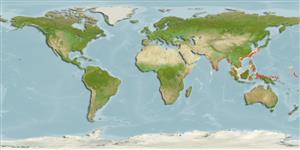
เกี่ยวกับทะเล,น้ำเค็ม; น้ำจืด; กร่อย สัตว์น้ำหน้าดิน; สัตว์น้ำจืดที่มีการอพยพอย่างแท้จริงภายในแหล่งน้ำจืดเท่านั้น (Ref. 51243); ระดับความลึก 50 - 100 m (Ref. 28016). Tropical; 33°N - 4°S
Indo-West Pacific: off the west and east coast of India, Sri Lanka, Pakistan, Bangladesh, Myanmar to the Arafura Sea (Ref. 9819) and the Indo-Australian Archipelago (excluding Australia). Known from the Mekong Delta (Ref. 12693).
ความยาวเมื่อครบกำหนดครั้งแรก / ขนาด / น้ำหนัก / อายุ
วัยเจริญพันธุ์: Lm ?, range 38 - ? cm
Max length : 80.0 cm TL เพศผู้/กระเทย; (Ref. 11441); common length : 30.0 cm TL เพศผู้/กระเทย; (Ref. 3290)
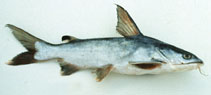
เงี่ยงครีบหลัง (รวม) : 1; ก้านครีบอ่อนที่หาง (รวม) : 7; ก้านครีบอ่อนที่ก้น: 16 - 30. Head shield somewhat rugose; deep and long median fontanelle groove.
Body shape (shape guide): fusiform / normal; Cross section: oval.
Adults occurs in inshore waters and estuaries. Occasionally form schools. Feed on invertebrates and small fishes. Males incubate eggs in the mouth (Ref. 205). Caught mainly with set bag nets and bamboo stake traps. Marketed fresh (Ref. 3290). Air bladders are exported as isinglass used by the wine industry (Ref. 43081). Strong venomous dorsal and pectoral spines provide protection for the fish (Ref. 43081).
Males incubate eggs in buccal cavity. During incubation, males starve which sometimes make them resort to swallowing one or two eggs probably to maintain basal metabolism (Ref. 43081). Early hatching embryos commence feeding on inhaled particles by the female when still in possession of large yolk.
Kailola, P.J., 1999. Ariidae (=Tachysuridae): sea catfishes (fork-tailed catfishes). p. 1827-1879. In K.E. Carpenter and V.H. Niem (eds.) FAO species identification guide for fishery purposes. The living marine resources of the Western Central Pacific. Vol. 3. Batoid fishes, chimaeras and bony fishes part 1 (Elopidae to Linophrynidae). FAO, Rome. (Ref. 38478)
สถานะบัญชีแดงของ IUCN (Ref. 130435: Version 2025-2 (Global))
ภัยคุกคามต่อมนุษย์
Traumatogenic (Ref. 58010)
การใช้ของมนุษย์
การประมง: การค้า
เครื่องมือ
รายงานพิเศษ
ดาวน์โหลด XML
แหล่งที่มาจากอินเตอร์เน็ต
การประมาณค่าตามแบบจำลอง
อุณหภูมิที่ต้องการ (อ้างอิง
123201): 22.5 - 28.2, mean 26.4 °C (based on 130 cells).
ดัชนีความหลากหลายทางวิวัฒนาการ (อ้างอิง
82804): PD
50 = 0.5000 [Uniqueness, from 0.5 = low to 2.0 = high].
Bayesian length-weight: a=0.00912 (0.00585 - 0.01422), b=3.06 (2.93 - 3.19), in cm total length, based on LWR estimates for this species & (Sub)family-body (Ref.
93245).
ระดับชั้นอาหาร (อ้างอิง
69278): 3.4 ±0.46 se; based on food items.
Generation time: 3.1 ( na - na) years. Estimated as median ln(3)/K based on 1
growth studies.
ความสามารถในการกลับคืนสู่ปกติ (อ้างอิง
120179): ขนาดกลาง, เวลาต่ำสุดที่จะทำให้ประชากรเพิ่มขึ้นเป็น 2 เท่าใช้เวลา 1.4 - 4.4 ปี (tmax=7).
ความเสี่ยงต่อการตกปลา (Ref.
59153): Moderate vulnerability (36 of 100).
🛈
สารอาหาร (Ref.
124155): Calcium = 153 [36, 364] mg/100g; Iron = 1.11 [0.72, 1.91] mg/100g; Protein = 17.6 [15.9, 19.4] %; Omega3 = 0.274 [0.153, 0.495] g/100g; Selenium = 75.9 [39.8, 145.3] μg/100g; VitaminA = 10.6 [4.7, 23.5] μg/100g; Zinc = 2.14 [0.49, 6.58] mg/100g (wet weight); based on
nutrient studies.