>
Siluriformes (Catfishes) >
Ariidae (Sea catfishes) > Ariinae
Etymology: Arius: Greek, arios, areios = dealing with Mars, warlike, bellicose (Ref. 45335).
Environnement : milieu / zone climatique / profondeur / gamme de distribution
Écologie
marin; eau douce; saumâtre démersal; potamodrome (Ref. 51243); profondeur 50 - 100 m (Ref. 28016). Tropical; 33°N - 4°S
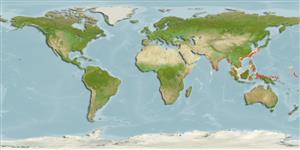
Indo-West Pacific: off the west and east coast of India, Sri Lanka, Pakistan, Bangladesh, Myanmar to the Arafura Sea (Ref. 9819) and the Indo-Australian Archipelago (excluding Australia). Known from the Mekong Delta (Ref. 12693).
Longueur à la première maturité / Taille / Poids / Âge
Maturité: Lm ?, range 38 - ? cm
Max length : 80.0 cm TL mâle / non sexé; (Ref. 11441); common length : 30.0 cm TL mâle / non sexé; (Ref. 3290)
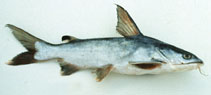
Épines dorsales (Total) : 1; Rayons mous dorsaux (Total) : 7; Rayons mous anaux: 16 - 30. Head shield somewhat rugose; deep and long median fontanelle groove.
Body shape (shape guide): fusiform / normal; Cross section: oval.
Adults occurs in inshore waters and estuaries. Occasionally form schools. Feed on invertebrates and small fishes. Males incubate eggs in the mouth (Ref. 205). Caught mainly with set bag nets and bamboo stake traps. Marketed fresh (Ref. 3290). Air bladders are exported as isinglass used by the wine industry (Ref. 43081). Strong venomous dorsal and pectoral spines provide protection for the fish (Ref. 43081).
Males incubate eggs in buccal cavity. During incubation, males starve which sometimes make them resort to swallowing one or two eggs probably to maintain basal metabolism (Ref. 43081). Early hatching embryos commence feeding on inhaled particles by the female when still in possession of large yolk.
Kailola, P.J., 1999. Ariidae (=Tachysuridae): sea catfishes (fork-tailed catfishes). p. 1827-1879. In K.E. Carpenter and V.H. Niem (eds.) FAO species identification guide for fishery purposes. The living marine resources of the Western Central Pacific. Vol. 3. Batoid fishes, chimaeras and bony fishes part 1 (Elopidae to Linophrynidae). FAO, Rome. (Ref. 38478)
Statut dans la liste rouge de l'IUCN (Ref. 130435: Version 2025-2 (Global))
Menace pour l'homme
Traumatogenic (Ref. 58010)
Utilisations par l'homme
Pêcheries: commercial
Outils
Articles particuliers
Télécharger en XML
Sources Internet
Estimations basées sur des modèles
Température préférée (Réf.
123201): 22.5 - 28.2, mean 26.4 °C (based on 130 cells).
Indice de diversité phylogénétique (Réf.
82804): PD
50 = 0.5000 [Uniqueness, from 0.5 = low to 2.0 = high].
Bayesian length-weight: a=0.00912 (0.00585 - 0.01422), b=3.06 (2.93 - 3.19), in cm total length, based on LWR estimates for this species & (Sub)family-body (Ref.
93245).
Niveau trophique (Réf.
69278): 3.4 ±0.46 se; based on food items.
Generation time: 3.1 ( na - na) years. Estimated as median ln(3)/K based on 1
growth studies.
Résilience (Réf.
120179): Milieu, temps minimum de doublement de population : 1,4 à 4,4 années (tmax=7).
Vulnérabilité de la pêche (Ref.
59153): Moderate vulnerability (36 of 100).
🛈
Nutriments (Ref.
124155): Calcium = 153 [36, 364] mg/100g; Iron = 1.11 [0.72, 1.91] mg/100g; Protein = 17.6 [15.9, 19.4] %; Omega3 = 0.274 [0.153, 0.495] g/100g; Selenium = 75.9 [39.8, 145.3] μg/100g; VitaminA = 10.6 [4.7, 23.5] μg/100g; Zinc = 2.14 [0.49, 6.58] mg/100g (wet weight); based on
nutrient studies.