>
Eupercaria/misc (Various families in series Eupercaria) >
Labridae (Wrasses) > Cirrhilabrinae
Etymology: Cirrhilabrus: Latin, cirrus = curl fringe + Greek, labros = furious (Ref. 45335).
Eponymy: Sir Peter Markham Scott (1909–1989) and his wife Philippa (1918–2010) were honoured “…in recognition of their great contribution in nature conservation. [...] (Ref. 128868), visit book page.
More on authors: Randall & Pyle.
Umwelt: Milieu / Klimazone / Tiefenbereich / Verbreitungsgebiet
Ökologie
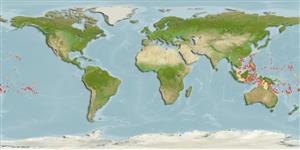
seewasser riff-verbunden; tiefenbereich 3 - 40 m (Ref. 9710). Tropical
Pacific Ocean: Great Barrier Reef to the Pitcairn Group.
Größe / Gewicht / Alter
Geschlechtsreife: Lm ? range ? - ? cm
Max length : 13.0 cm TL Männchen/unbestimmt; (Ref. 2334)
Rückenflossenstacheln (insgesamt) : 11; Rückenflossenweichstrahlen (insgesamt) : 9; Afterflossenstacheln: 3; Afterflossenweichstrahlen: 9. Body is green posteriorly , shading to dusky blue-green in the middle, and to brighter blue-green anteriorly and on postorbital portion of the head; lower fourth of the body light red; postorbital head and anterior upper half of the body finely speckled with black; snout greenish yellow.
Body shape (shape guide): fusiform / normal; Cross section: compressed.
More common in outer reef areas than sheltered lagoon reefs. Usually seen in small groups feeding a short distance above the bottom on zooplankton. These groups are composed mainly of females and juveniles. Males in courtship, actively swim up to 3 m or more above the bottom with fins fully erect.
Lebenszyklus und Paarungsverhalten
Geschlechtsreife | Fortpflanzung | Ablaichen | Eier | Fruchtbarkeit | Larven
Distinct pairing during breeding (Ref. 205).
Randall, J.E., G.R. Allen and R.C. Steene, 1990. Fishes of the Great Barrier Reef and Coral Sea. University of Hawaii Press, Honolulu, Hawaii. 506 p. (Ref. 2334)
IUCN Rote Liste Status (Ref. 130435: Version 2025-2 (Global))
Bedrohung für Menschen
Harmless
Nutzung durch Menschen
Fischereien: kommerziell; Aquarium: Kommerziell
Tools
Zusatzinformationen
Download XML
Internet Quellen
Schätzungen auf der Grundlage von Modellen
Bevorzugte Temperatur (Ref.
123201): 24.7 - 28.9, mean 27.4 °C (based on 160 cells).
Phylogenetischer Diversitätsindex (Ref.
82804): PD
50 = 0.5000 [Uniqueness, from 0.5 = low to 2.0 = high].
Bayesian length-weight: a=0.01072 (0.00427 - 0.02691), b=3.03 (2.81 - 3.25), in cm total length, based on LWR estimates for this (Sub)family-body shape (Ref.
93245).
Trophische Ebene (Ref.
69278): 3.4 ±0.45 se; based on food items.
Widerstandsfähigkeit (Ref.
120179): hoch, Verdopplung der Population dauert weniger als 15 Monate. (Preliminary K or Fecundity.).
Anfälligkeit der Fischerei (Ref.
59153): Low vulnerability (10 of 100).
🛈
Nährstoffe (Ref.
124155): Calcium = 98.6 [57.7, 182.2] mg/100g; Iron = 0.881 [0.506, 1.670] mg/100g; Protein = 18.2 [15.3, 20.4] %; Omega3 = 0.161 [0.095, 0.269] g/100g; Selenium = 23.7 [13.6, 46.1] μg/100g; VitaminA = 226 [69, 811] μg/100g; Zinc = 1.7 [1.1, 2.7] mg/100g (wet weight);