分類 / 名稱
俗名 | 同種異名 | Catalog of Fishes(屬, 種) | ITIS | CoL | WoRMS | Cloffa
Teleostei >
Eupercaria/misc (Various families in series Eupercaria)
鱸形目 (Various families in series Eupercaria) >
Labridae (Wrasses)
隆頭魚科 (Wrasses) > Cirrhilabrinae
Etymology: Cirrhilabrus: Latin, cirrus = curl fringe + Greek, labros = furious (Ref. 45335).
Eponymy: Sir Peter Markham Scott (1909–1989) and his wife Philippa (1918–2010) were honoured “…in recognition of their great contribution in nature conservation. [...] (Ref. 128868), visit book page.
More on authors: Randall & Pyle.
環境: 環境 / 氣候帶 / 深度上下限 / 配送範圍
生態學
海洋 礁區魚類; 深度上下限 3 - 40 m (Ref. 9710). 熱帶
分布
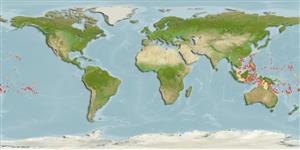
領土 | FAO區域 | 生態系 | 發現紀錄 | 分布圖 | 簡介 | Faunafri
Pacific Ocean: Great Barrier Reef to the Pitcairn Group.
太平洋: 大堡礁到皮特凱恩島聚集。
大小 / 重量 / 年齡
成熟度: Lm ? range ? - ? cm
Max length : 13.0 cm TL 雄魚/尚未辨別雌雄; (Ref. 2334)
背棘 (總數) : 11; 背的軟條 (總數) : 9; 臀棘: 3; 臀鰭軟條: 9. Body is green posteriorly , shading to dusky blue-green in the middle, and to brighter blue-green anteriorly and on postorbital portion of the head; lower fourth of the body light red; postorbital head and anterior upper half of the body finely speckled with black; snout greenish yellow.
Body shape (shape guide): fusiform / normal; Cross section: compressed.
身體在後部地是綠色的 , 顏色變化成暗色的藍綠色在中央中, 與到淡藍色-綠色前面地與在頭部的眼眶後部分上; 身體的下面四分之一淡紅色; 眼眶後的頭部與身體的前面上半部有黑色的細斑點; 吻黃綠色的。
More common in outer reef areas than sheltered lagoon reefs. Usually seen in small groups feeding a short distance above the bottom on zooplankton. These groups are composed mainly of females and juveniles. Males in courtship, actively swim up to 3 m or more above the bottom with fins fully erect.
超過掩蔽的潟湖礁較常見於外圍礁石區域。 在浮游動物上常被見到形成小群魚群進食在底部上面的短距離。 這些群被主要地母魚與稚魚組成。 在求偶期中的雄性, 活躍地游泳在底部上面的向上到 3個公尺或更多,把鰭完全豎立起來。
生命週期和交配行為
成熟度 | 繁殖 | 產卵場 | 卵 | 孕卵數 | 仔魚
Distinct pairing during breeding (Ref. 205).太平洋: 大堡礁到皮特凱恩島聚集。
Randall, J.E., G.R. Allen and R.C. Steene, 1990. Fishes of the Great Barrier Reef and Coral Sea. University of Hawaii Press, Honolulu, Hawaii. 506 p. (Ref. 2334)
IUCN 瀕危狀態 (Ref. 130435: Version 2025-2 (Global))
無危 (LC) ; Date assessed: 10 March 2009
人類使用
漁業: 商業性; 水族館: 商業性
工具
特別的報告
下載 XML
網路資源
基於模型的估計
首選溫度 (參考文獻
123201): 24.7 - 28.9, mean 27.4 °C (based on 160 cells).
系統發育多樣性指數 (參考文獻
82804): PD
50 = 0.5000 [Uniqueness, from 0.5 = low to 2.0 = high].
Bayesian length-weight: a=0.01072 (0.00427 - 0.02691), b=3.03 (2.81 - 3.25), in cm total length, based on LWR estimates for this (Sub)family-body shape (Ref.
93245).
營養階層 (參考文獻
69278): 3.4 ±0.45 se; based on food items.
回復力 (參考文獻
120179): 高度, 族群倍增時間少於 15個月 (Preliminary K or Fecundity.).
釣魚的脆弱性 (Ref.
59153): Low vulnerability (10 of 100).
🛈
營養素 (Ref.
124155): Calcium = 98.6 [57.7, 182.2] mg/100g; Iron = 0.881 [0.506, 1.670] mg/100g; Protein = 18.2 [15.3, 20.4] %; Omega3 = 0.161 [0.095, 0.269] g/100g; Selenium = 23.7 [13.6, 46.1] μg/100g; VitaminA = 226 [69, 811] μg/100g; Zinc = 1.7 [1.1, 2.7] mg/100g (wet weight);