Ambiente: milieu / zona climática / intervalo de profundidade / gama de distribuição
Ecologia
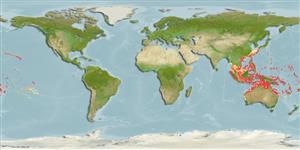
marinhas associadas(os) a recifes; intervalo de profundidade 0 - 90 m (Ref. 9710), usually 5 - 30 m (Ref. 37792). Tropical; 35°N - 30°S, 105°E - 130°W
East Indian Ocean from Christmas Pacific Ocean: Honshu, Japan south to the Great Barrier Reef and New Caledonia and east to the Hawaiian Islands, French Polynesia, and Pitcairn. Eastern Pacific: Clipperton Island. Once regarded a wide-ranging Indo-Pacific species, the Indian Ocean population is now recognized as a separate species, Naso elegans.
Tamanho / Peso / Idade
Maturidade: Lm ? range ? - ? cm
Max length : 46.0 cm SL macho/indeterminado; (Ref. 37792); peso máx. Publicado: 2.3 kg (Ref. 125599)
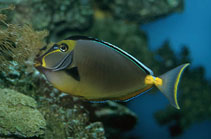
Espinhos dorsais (total) : 6; Raios dorsais moles (total) : 26 - 29; Espinhos anais: 2; Raios anais moles: 27 - 30. This species is distinguished by the following characters: D VI (rarely V or VII),26-29(modally 27); A II,27-30 (rarely 27 or 30); pectoral rays usually 17; body depths of adults 2.6-3.0 in SL; head dorsal profile sloping and smoothly convex (forehead no horn nor protuberances); two large peduncular plates, the keels with forward-projecting points in adults; caudal fin emaginate in young and truncate in adults; body brown to bluish gray, ventral half yellowish gray to yellow, the demarcation along middle of side often abrupt and irregular; edge of opercle and preopercle usually with a dark brown band; margin of lower lip broadly white with upper surface of tongue black in adults; gill rakers are blackish basally; blue caudal fin with a broad, brownish yellow, posterior border which narrows toward corners of fin; it is capable of changing overall into light grayish blue, as when at a cleaning station; when in courtship the males quickly display a broad, bluish white zone on the nape and anterior part of the body , followed by narrow bars of the same color that extend onto lower side (Ref. 54980).
Body shape (shape guide): short and / or deep; Cross section: compressed.
Found in areas of coral, rock, or rubble of lagoon and seaward reefs, Ref. 48637. Benthopelagic (Ref. 58302). Adults usually in small groups. Juveniles in shallow rocky reefs, sometimes in small aggregations mixed with other acanthurids of similar size (Ref. 48637). Feed mainly on leafy brown algae (Sargassum and Dictyota). Sometimes in large aggregations (Ref. 37792). Very seldom poisonous (Ref. 4795). Pair-spawning has been observed.
Ciclo de vida e comportamento de acasalamento
Maturidade | Reprodução | Desova | Ovos | Fecundidade | Larvas
Probably spawn in pairs (Ref. 240).
Randall, J.E., G.R. Allen and R.C. Steene, 1990. Fishes of the Great Barrier Reef and Coral Sea. University of Hawaii Press, Honolulu, Hawaii. 506 p. (Ref. 2334)
Categoria na Lista Vermelha da IUCN (Ref. 130435: Version 2025-2 (Global))
Utilização humana
Pescarias: pouco comercial; Aquário: Espécies comerciais
Ferramentas
Relatórios especiais
Descarregue XML
Fontes da internet
Estimativas baseadas em modelos
Temperatura preferida (Ref.
123201): 24.5 - 28.9, mean 27.7 °C (based on 734 cells).
Índice de diversidade filogenética (Ref.
82804): PD
50 = 0.5000 [Uniqueness, from 0.5 = low to 2.0 = high].
Bayesian length-weight: a=0.02818 (0.01747 - 0.04547), b=2.96 (2.82 - 3.10), in cm total length, based on LWR estimates for this species & (Sub)family-body (Ref.
93245).
Nível Trófico (Ref.
69278): 2.3 ±0.19 se; based on food items.
Generation time: 3.1 ( na - na) years. Estimated as median ln(3)/K based on 1
growth studies.
Resiliência (Ref.
120179): Médio, tempo mínimo de duplicação da população 1,4 - 4,4 anos (K=0.3).
Vulnerabilidade da pesca (Ref.
59153): Low to moderate vulnerability (34 of 100).
🛈
Nutrientes (Ref.
124155): Calcium = 39.2 [20.9, 64.0] mg/100g; Iron = 0.548 [0.291, 0.982] mg/100g; Protein = 18.3 [17.0, 19.5] %; Omega3 = 0.107 [0.068, 0.183] g/100g; Selenium = 42.6 [22.1, 79.5] μg/100g; VitaminA = 35.3 [8.6, 134.5] μg/100g; Zinc = 1.18 [0.78, 1.74] mg/100g (wet weight);