البيئة: الوسط / المنطقة المناخية / نطاق العمق / نطاق التوزيع
البيئة
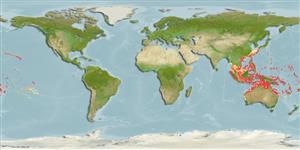
بحري مرتبطة بالشعاب; نطاق العمق 0 - 90 m (Ref. 9710), usually 5 - 30 m (Ref. 37792). Tropical; 35°N - 30°S, 105°E - 130°W
East Indian Ocean from Christmas Pacific Ocean: Honshu, Japan south to the Great Barrier Reef and New Caledonia and east to the Hawaiian Islands, French Polynesia, and Pitcairn. Eastern Pacific: Clipperton Island. Once regarded a wide-ranging Indo-Pacific species, the Indian Ocean population is now recognized as a separate species, Naso elegans.
الحجم / وزن / العمر
النضج: Lm ? range ? - ? cm
Max length : 46.0 cm SL ذكر/ مختلط الجنس; (Ref. 37792); أعلا وزن تم نشرة: 2.3 kg (Ref. 125599)
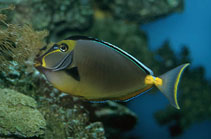
الأشواك الظهرية (المجموع) : 6; الأشعة الظهرية الناعمة (المجموع) : 26 - 29; شوكة شرجية: 2; أشعه شرجية لينه: 27 - 30. This species is distinguished by the following characters: D VI (rarely V or VII),26-29(modally 27); A II,27-30 (rarely 27 or 30); pectoral rays usually 17; body depths of adults 2.6-3.0 in SL; head dorsal profile sloping and smoothly convex (forehead no horn nor protuberances); two large peduncular plates, the keels with forward-projecting points in adults; caudal fin emaginate in young and truncate in adults; body brown to bluish gray, ventral half yellowish gray to yellow, the demarcation along middle of side often abrupt and irregular; edge of opercle and preopercle usually with a dark brown band; margin of lower lip broadly white with upper surface of tongue black in adults; gill rakers are blackish basally; blue caudal fin with a broad, brownish yellow, posterior border which narrows toward corners of fin; it is capable of changing overall into light grayish blue, as when at a cleaning station; when in courtship the males quickly display a broad, bluish white zone on the nape and anterior part of the body , followed by narrow bars of the same color that extend onto lower side (Ref. 54980).
Body shape (shape guide): short and / or deep; Cross section: compressed.
Found in areas of coral, rock, or rubble of lagoon and seaward reefs, Ref. 48637. Benthopelagic (Ref. 58302). Adults usually in small groups. Juveniles in shallow rocky reefs, sometimes in small aggregations mixed with other acanthurids of similar size (Ref. 48637). Feed mainly on leafy brown algae (Sargassum and Dictyota). Sometimes in large aggregations (Ref. 37792). Very seldom poisonous (Ref. 4795). Pair-spawning has been observed.
دورة الحياة وسلوك التزاوج
النضج | التكاثر | وضع البيض | بيض | الخصوبة | اليرقات
Probably spawn in pairs (Ref. 240).
Randall, J.E., G.R. Allen and R.C. Steene, 1990. Fishes of the Great Barrier Reef and Coral Sea. University of Hawaii Press, Honolulu, Hawaii. 506 p. (Ref. 2334)
حالة القائمة الحمراء للاتحاد الدولي لحفظ الطبيعة والموارد الطبيعية (Ref. 130435: Version 2025-2 (Global))
استخدامات بشرية
مصائد: غير مهمة تجارياً; حوض مائي: تجاري
أدوات
تقارير خاصة
تنزيل XML
مصادر علي الأنترنت
تقديرات تستند إلى النماذج
درجة الحرارة المفضلة (مرجع
123201): 24.5 - 28.9, mean 27.7 °C (based on 734 cells).
مؤشر التنوع الشُعبي الوراثي (مرجع
82804): PD
50 = 0.5000 [Uniqueness, from 0.5 = low to 2.0 = high].
Bayesian length-weight: a=0.02818 (0.01747 - 0.04547), b=2.96 (2.82 - 3.10), in cm total length, based on LWR estimates for this species & (Sub)family-body (Ref.
93245).
مستوى غذائي (مرجع
69278): 2.3 ±0.19 se; based on food items.
Generation time: 3.1 ( na - na) years. Estimated as median ln(3)/K based on 1
growth studies.
المرونه (مرجع
120179): وسيط, الحد الزمني الأدني لتضاعف عدد أفراد المجتمع 1.4-4.4 سنة (K=0.3).
ضعف الصيد (Ref.
59153): Low to moderate vulnerability (34 of 100).
🛈
المغذيات (Ref.
124155): Calcium = 39.2 [20.9, 64.0] mg/100g; Iron = 0.548 [0.291, 0.982] mg/100g; Protein = 18.3 [17.0, 19.5] %; Omega3 = 0.107 [0.068, 0.183] g/100g; Selenium = 42.6 [22.1, 79.5] μg/100g; VitaminA = 35.3 [8.6, 134.5] μg/100g; Zinc = 1.18 [0.78, 1.74] mg/100g (wet weight);